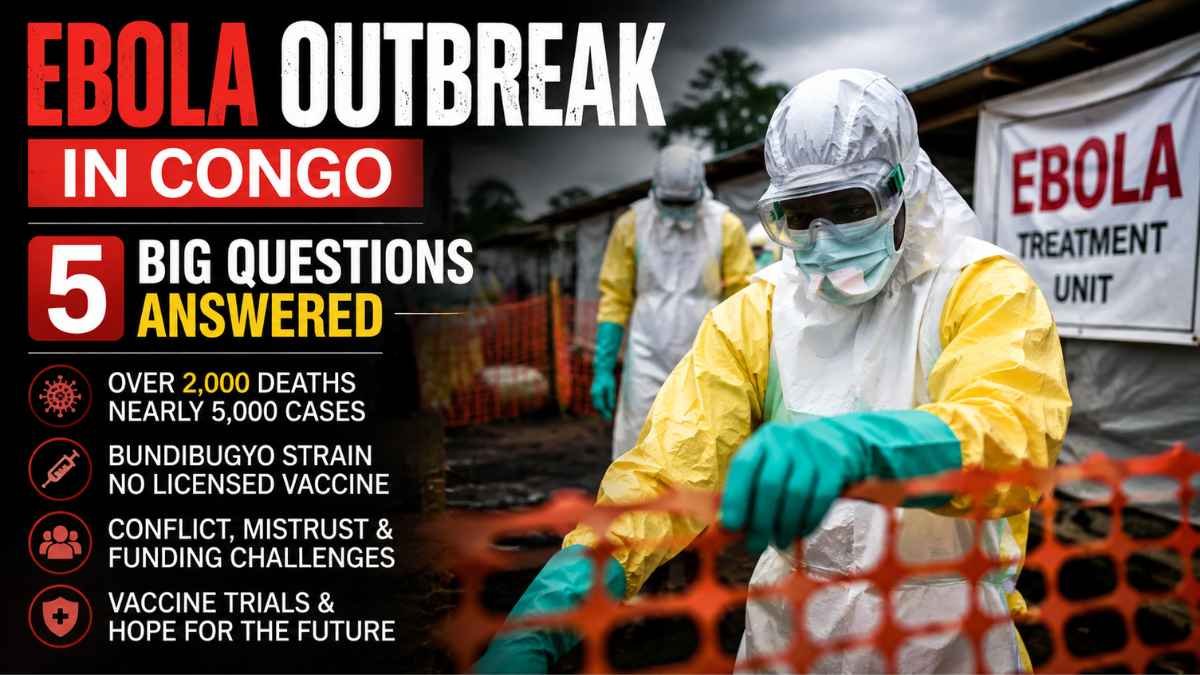
The Ebola outbreak in the Democratic Republic of the Congo (DRC) has become the country's biggest and deadliest Ebola outbreak in history. Nearly 5,000 confirmed cases and more than 2,000 deaths have been recorded since the outbreak was declared on May 15, 2026.
The outbreak is being driven by the Bundibugyo strain of Ebola, a rarer form of the virus for which there is currently no licensed vaccine or treatment. Health authorities are now racing to contain transmission before the outbreak becomes the largest Ebola epidemic ever recorded.
Here are five major questions surrounding the crisis.
1. Why Are Ebola Cases and Deaths Still Increasing?
One of the biggest problems is that the outbreak appears to have been spreading for months before it was officially detected.
Although the DRC declared the outbreak on May 15, genetic sequencing suggests transmission had already begun in February. By the time authorities responded, the virus had gained a significant head start.
The situation is particularly difficult in Ituri and North Kivu, where armed conflict and population displacement have made contact tracing extremely challenging.
Africa CDC estimates that only around 12% of contacts are currently being traced, compared with a target of 95%. Authorities are therefore changing their strategy and moving toward door-to-door searches for people showing symptoms, with local representatives being appointed in villages to help identify cases.
2. What Happened to the 850 People Who Are Unaccounted For?
This is one of the most worrying aspects of the outbreak.
As of August 15, the DRC had recorded 4,945 confirmed cases. Of these, 730 people were in treatment centres, 1,040 had survived and 2,325 had died.
That leaves around 850 confirmed patients unaccounted for in those categories.
Health officials are concerned because people infected with Ebola who cannot be located may continue transmitting the virus.
The problem is made worse by widespread mistrust of authorities. Some patients avoid treatment centres, while some families choose to care for infected relatives at home.
Traditional burial practices can also create additional transmission risks because Ebola spreads through contact with infected body fluids, including from people who have died.
3. Is the Money Promised for the Ebola Response Reaching the Frontline?
Funding is another major challenge.
Africa CDC estimates that around $518 million is required for the direct Ebola response, with another $882 million needed for wider humanitarian needs.
International donors have pledged enough money to cover the required amount, but much of it has not yet reached frontline operations. According to WHO director general Tedros Adhanom Ghebreyesus, only $264 million of the $518 million required for the direct health response had been disbursed.
There have also been serious problems with access to physical cash in remote areas.
Some healthcare workers, including nurses and teams involved in safe burials, have gone on strike over unpaid wages. That creates another obstacle for an already stretched response effort.
4. Do We Have a Vaccine or Treatment for This Ebola Strain?
This is one of the most important differences between the current outbreak and previous Ebola crises.
The current outbreak involves the Bundibugyo strain, for which there is currently no licensed vaccine or medicine.
However, there are some developments offering hope.
Clinical trials have begun for two vaccines specifically designed to protect against the Bundibugyo strain. Trials of potential treatments are also underway.
Researchers are also investigating whether the existing Ervebo vaccine, which was developed against the Zaire strain of Ebola, could provide some cross-protection against Bundibugyo.
Officials are considering using it because early evidence suggests it could potentially reduce deaths even if it does not completely prevent infection.
The coming months will be critical in determining whether these vaccines and treatments can prove effective.
5. What Could the Ebola Outbreak Look Like 100 Days From Now?
The outbreak is unlikely to be over by early December.
WHO officials are instead hoping that the new village-by-village strategy will help reverse transmission within approximately three months.
One important measure will be the case-fatality rate.
As of August 15, around 47% of confirmed patients had died. A decline in that figure could indicate that people are being identified and treated earlier.
Another major concern is whether Ebola spreads further into neighbouring countries.
South Sudan, which borders Ituri, is already facing a major humanitarian crisis. Authorities there have increased surveillance and trained healthcare workers in border areas to identify potential Ebola cases.
Could This Become the Largest Ebola Outbreak Ever?
That possibility is now a serious concern.
The previous largest Ebola outbreak occurred in West Africa between 2014 and 2016, when more than 28,000 people were infected and over 11,000 died.
The current DRC outbreak is already the country's deadliest Ebola outbreak and is growing faster than the previous West African epidemic did during its early stages.
The biggest difference is the speed of the current outbreak.
The West African outbreak took almost five months to reach 1,000 deaths. The DRC outbreak has recorded more than 2,000 deaths in less than three months.
Why Is Containing Ebola So Difficult in the DRC?
The virus itself is only part of the problem.
The response is taking place in areas affected by:
- Armed conflict
- Population displacement
- Misinformation
- Distrust of health authorities
- Attacks on healthcare facilities
- Poor transport infrastructure
- Unpaid healthcare workers
- Insufficiently disbursed funding
In some of the worst-hit communities, people are reluctant to visit Ebola treatment centres because of fear and distrust. More than 70% of deaths have reportedly occurred in communities rather than health centres, according to WHO's regional Africa director.
This means authorities are increasingly focusing on finding patients inside their communities, rather than waiting for them to arrive at treatment centres.
Is There Any Reason for Hope?
Despite the severity of the outbreak, there are some positive developments.
Two Bundibugyo vaccines are now being tested in humans, while potential treatments are undergoing clinical trials. Laboratory testing has also become more accessible in Ituri, reducing the need to send samples to Kinshasa for confirmation.
Uganda also provides an example of what rapid containment can achieve. After recording 20 cases and two deaths linked to imported infections, Uganda was declared Ebola-free on July 28 after no community transmission was detected.
The challenge for the DRC is bringing that level of surveillance, trust and response capacity to areas affected by conflict and limited infrastructure.
The Bottom Line
The 2026 Ebola outbreak in the Democratic Republic of the Congo has already become the deadliest Ebola outbreak in the country's history, with nearly 5,000 confirmed cases and more than 2,000 deaths.
The biggest concerns are the large number of unaccounted-for infected people, limited contact tracing, conflict, mistrust and delays in getting funding to frontline workers.
At the same time, vaccine and treatment trials offer a potential path forward. Whether those efforts can reverse the outbreak before it surpasses the historic 2014–2016 West Africa Ebola epidemic could depend on how quickly international funding, healthcare workers and local communities can work together.