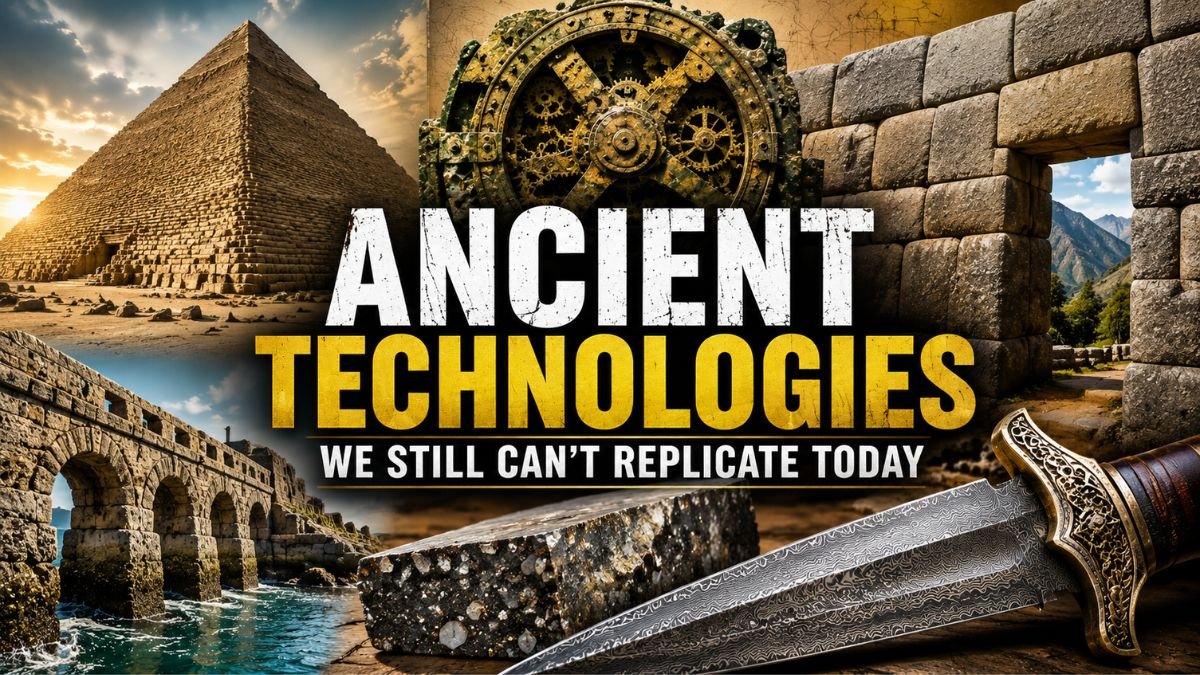
Ancient Technologies continue to amaze historians, engineers, and scientists around the world. Despite modern computers, advanced machinery, and cutting-edge manufacturing techniques, some ancient inventions and engineering achievements remain difficult to fully replicate even today.
This raises an intriguing question.
How did ancient civilizations accomplish feats that still challenge modern experts?
From mysterious construction methods to advanced materials, the past may have been more technologically sophisticated than many people realize.
Were Ancient Civilizations More Advanced Than We Think?
Ancient societies did not have electricity, computers, or modern factories.
However, they possessed generations of practical knowledge, craftsmanship, and engineering skills.
Many techniques were passed down through apprenticeships rather than written records.
When those civilizations declined, some of that knowledge disappeared with them.
As a result, historians are still trying to understand how certain achievements were possible.
Roman Concrete
One of the most famous examples of Ancient Technologies is Roman concrete.
Many Roman structures have survived for nearly two thousand years.
Some ancient harbors and seawalls remain standing despite constant exposure to seawater.
Modern concrete often deteriorates much faster.
Researchers have spent years studying Roman concrete in an effort to understand its remarkable durability.
While scientists have uncovered some of its secrets, recreating its long-term performance remains a challenge.
Damascus Steel
For centuries, Damascus steel was legendary.
The material was known for its distinctive patterns, strength, and sharpness.
Historical accounts described swords capable of extraordinary performance.
Eventually, the original manufacturing technique was lost.
Although modern metallurgists have produced similar materials, the exact process used by ancient craftsmen remains uncertain.
This makes Damascus steel one of history's most famous lost ancient technologies.
The Antikythera Mechanism
Discovered in a shipwreck near Greece, the Antikythera Mechanism shocked researchers.
The device dates back more than two thousand years and contains a complex system of gears.
Many experts consider it the world's first known analog computer.
It was capable of tracking astronomical events with remarkable precision.
The sophistication of the mechanism was far beyond what historians expected from its time period.
Even today, it remains one of the most mysterious ancient inventions ever discovered.
Inca Stonework
The Inca civilization built massive structures using enormous stones fitted together with astonishing precision.
Some stones weigh many tons.
Yet the gaps between them are often so small that even a thin blade cannot fit through.
What makes this achievement even more impressive is the lack of modern construction equipment.
Historians continue debating exactly how the Incas achieved such extraordinary accuracy.
Egyptian Pyramid Construction
The Great Pyramid of Giza remains one of the world's greatest engineering mysteries.
Millions of stone blocks were transported and assembled with remarkable precision.
Despite decades of research, experts still debate the exact construction methods used.
Various theories have been proposed, but no explanation answers every question.
The pyramids continue to inspire fascination because of the immense scale of the project.
Greek Fire
Greek Fire was a powerful weapon reportedly used by the Byzantine Empire.
Historical descriptions suggest it could burn even on water.
Its exact formula was a closely guarded secret.
When the knowledge disappeared, the recipe vanished as well.
Today, historians still do not know precisely how it was made.
Why Was So Much Knowledge Lost?
Many ancient technologies disappeared because knowledge was not always written down.
Wars, invasions, natural disasters, and the collapse of civilizations often destroyed important records.
In some cases, skilled craftsmen died without passing their techniques to future generations.
Over time, entire technologies faded into history.
What Can We Learn From Ancient Technologies?
Studying Ancient Technologies helps researchers better understand the capabilities of past civilizations.
These discoveries challenge assumptions about human innovation and engineering.
They also remind us that technological progress is not always a straight line.
Sometimes knowledge can be lost as easily as it is gained.
FAQs
What are Ancient Technologies?
Ancient Technologies are inventions, engineering methods, and materials developed by ancient civilizations.
What is the most famous lost ancient technology?
The Antikythera Mechanism, Roman concrete, and Damascus steel are among the most famous examples.
Why can't we replicate some ancient technologies?
In many cases, the original methods and materials were never fully recorded and were lost over time.
Is Roman concrete better than modern concrete?
In certain environments, particularly seawater, Roman concrete appears remarkably durable.
What makes the Antikythera Mechanism special?
It is considered the world's earliest known analog computer and demonstrates advanced engineering for its era.