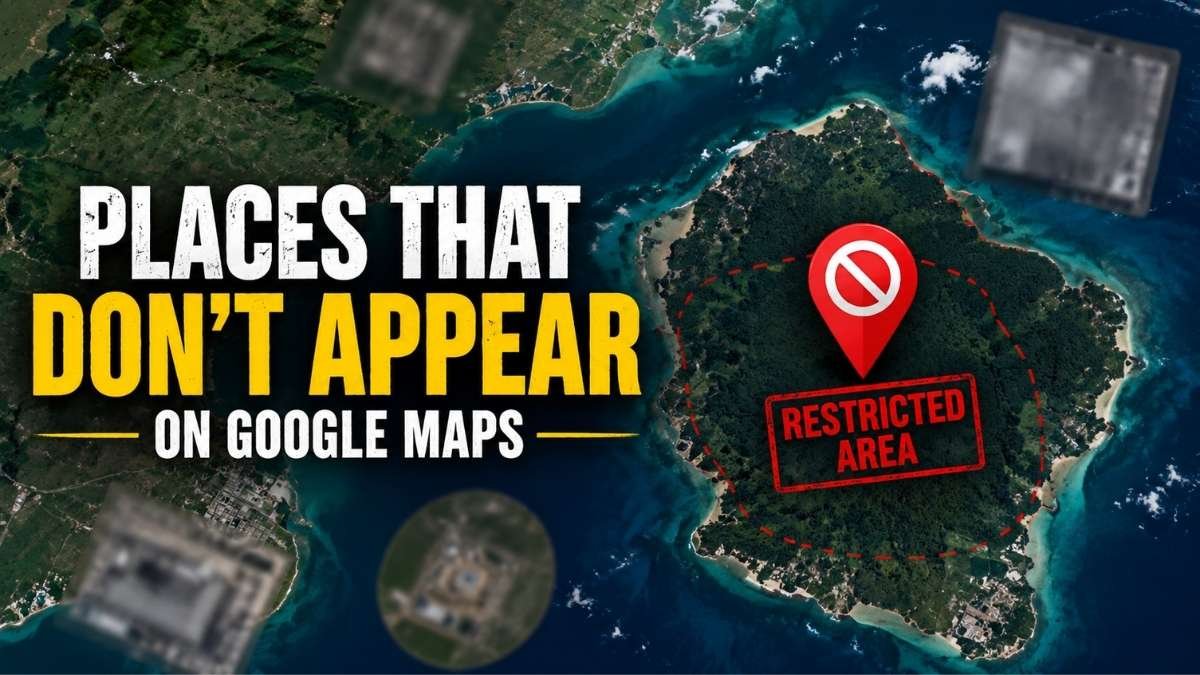
Places that don't appear on Google Maps sound like something from a conspiracy theory.
After all, Google Maps has photographed nearly every corner of the planet. From busy city streets to remote deserts, it often feels as if nowhere can stay hidden anymore.
But that's not entirely true.
Even today, there are places around the world that are blurred, restricted, hidden, or difficult to view on public mapping services.
Some are protected for security reasons.
Others are hidden to protect wildlife, cultural sites, or private communities.
And a few remain mysterious.
Here are some of the most fascinating places that don't appear on Google Maps the way you might expect.
1. North Sentinel Island
One of the most famous examples is North Sentinel Island.
Located in the Indian Ocean, the island is home to the Sentinelese, one of the world's last uncontacted tribes.
The Indian government restricts access to the island and protects the tribe from outside contact.
While the island itself can be seen from satellite imagery, detailed exploration is impossible.
Its isolation has made it one of the most mysterious places on Earth.
2. Military Installations
Many countries limit what can be seen around sensitive military facilities.
Some locations appear blurred or outdated.
Governments often request restrictions for security reasons.
The exact policies vary from country to country, but military sites remain among the most common examples of limited map visibility.
3. Secret Research Facilities
Certain research centers and government installations receive special treatment on mapping platforms.
These locations may be partially obscured, shown with lower resolution, or represented using older imagery.
In some cases, restrictions are intended to prevent sensitive information from becoming publicly available.
4. Protected Archaeological Sites
Not every hidden location is secret.
Some archaeological sites are intentionally protected from tourism and vandalism.
Publicizing precise locations can attract looters or damage fragile historical remains.
As a result, authorities occasionally limit publicly available information.
5. Remote Indigenous Communities
Some isolated communities prefer minimal outside attention.
Governments and organizations sometimes avoid publishing detailed location information to protect residents and preserve traditional ways of life.
These communities are often located in forests, deserts, or other remote environments.
6. Private Islands
Around the world, some privately owned islands restrict public access.
While many still appear on maps, detailed information may be limited.
Owners often prioritize privacy and security.
For that reason, some islands remain surprisingly difficult to explore online.
7. Restricted Government Sites
Governments operate facilities that are not intended for public access.
While satellite technology has made complete secrecy difficult, certain locations still receive special treatment.
Some appear with reduced detail, while others are represented using older imagery.
Why Are Some Places Hidden?
Most hidden locations fall into three categories.
Security
Military and government facilities often restrict public visibility.
Safety
Some places are hidden to protect people from danger.
Preservation
Historical sites, wildlife habitats, and indigenous communities may be protected from excessive attention.
In many cases, the goal isn't secrecy—it's protection.
Can Anything Truly Be Hidden Today?
Not completely.
Modern satellites continuously photograph the Earth's surface.
However, there is a difference between being visible from space and being easily accessible to the public.
Even in the age of the internet, some places remain difficult to explore.
That mystery is part of what makes them so fascinating.
FAQs
Are there really places that don't appear on Google Maps?
Yes. Some locations are blurred, restricted, or shown with limited detail for security, privacy, or preservation reasons.
Why is North Sentinel Island famous?
It is home to one of the world's last uncontacted tribes and is protected from outside contact.
Does Google hide military bases?
In some countries, sensitive military facilities may appear blurred or less detailed.
Can governments request map restrictions?
Yes. Certain governments and agencies can request restrictions for security purposes.
Are hidden places always secret?
No. Many are protected for environmental, cultural, or safety reasons rather than secrecy.
The Bottom Line
Places that don't appear on Google Maps remind us that not everything has been fully documented online.
While modern technology has made the world more visible than ever, some locations remain protected, restricted, or intentionally difficult to explore.
In a world where almost everything can be found with a search, those hidden places continue to capture our imagination.