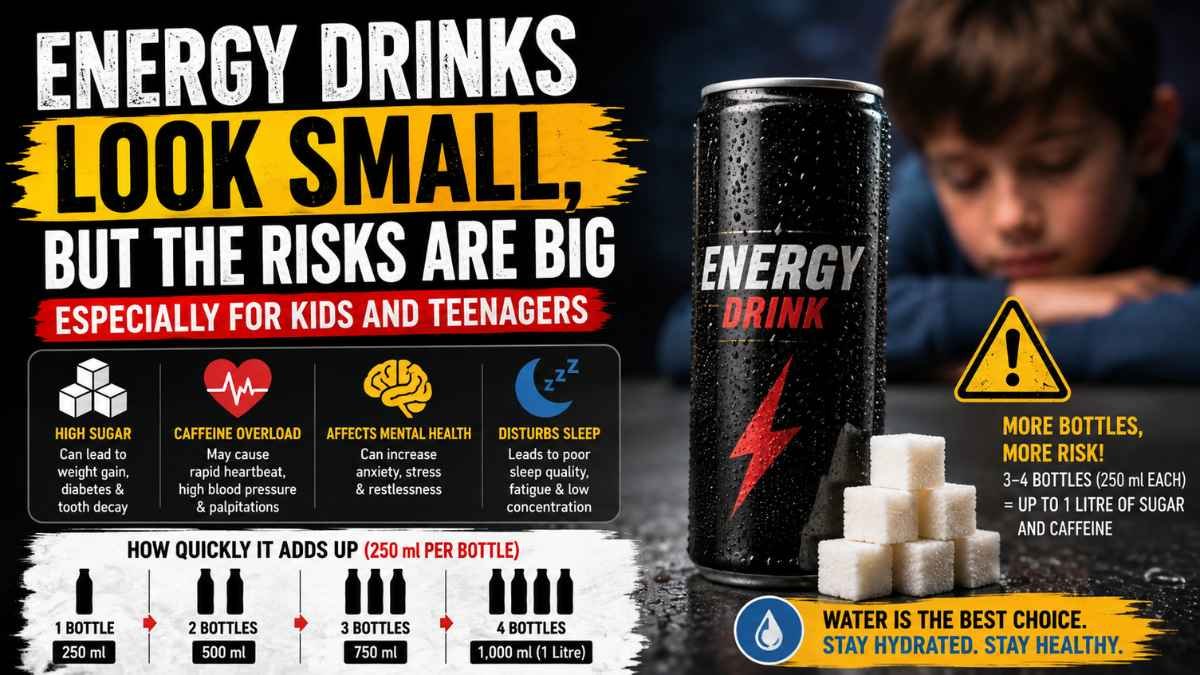
Energy drinks side effects are becoming harder to ignore as sugary, caffeinated beverages become increasingly common among teenagers and even younger children. A small 250 ml bottle may not look like much, but drinking two, three or even four bottles can quickly turn into a much larger intake of sugar and caffeine.
The concern is not simply about the size of the bottle. It is about what is inside it, how much is consumed, and how frequently it is being consumed.
For children and teenagers, the issue becomes even more important because health experts advise against energy drinks for this age group due to their caffeine and sugar content.
Why does a 250 ml bottle matter?
A 250 ml bottle can look relatively small compared with a large soft drink bottle. That can make it easy to underestimate how much someone has actually consumed.
Consider this:
- 1 bottle = 250 ml
- 2 bottles = 500 ml
- 3 bottles = 750 ml
- 4 bottles = 1,000 ml, or 1 litre
So someone who thinks they are only having "a small bottle" can end up drinking an entire litre if they have four.
And the important part is that the amount of sugar and caffeine increases with every bottle.
The exact amount varies by product, so the nutrition label matters. If one 250 ml serving contains a particular amount of sugar or caffeine, drinking three bottles means consuming roughly three times that amount, while four bottles means roughly four times that amount.
That is why looking only at the bottle size can be misleading.
The sugar problem is bigger than many people realize
Many energy drinks contain significant amounts of added or free sugars. These sugars provide calories but relatively little nutritional value.
WHO recommends that free sugars should make up less than 10% of total daily energy intake, with a further reduction to below 5% providing additional health benefits. WHO also links higher consumption of sugar-sweetened beverages with increased risk of overweight and obesity in children.
The problem becomes particularly obvious when sugary drinks are consumed regularly.
A child may drink an energy drink after school, have another while playing games, and then consume additional sugary foods or drinks during the same day. The sugar from each source adds up.
Over time, consistently consuming more calories than the body needs can contribute to unhealthy weight gain.
What can too much sugar do to children?
High sugar consumption is not just about gaining weight.
Regularly consuming drinks high in free sugars can contribute to:
- Unhealthy weight gain
- Increased risk of overweight and obesity
- Poor overall dietary quality
- Higher risk of dental cavities
- Greater exposure to calories without much nutritional value
WHO specifically identifies free sugars as an important risk factor for dental caries and notes that sugary beverages can contribute to childhood overweight and obesity.
Teeth can also pay the price
There is another problem that is easy to overlook: dental health.
When sugar is consumed, bacteria in dental plaque can use those sugars and produce acids that damage tooth surfaces. Repeated exposure to free sugars increases the risk of dental caries, commonly known as cavities.
For a child who frequently drinks sugary beverages throughout the day, the problem is not necessarily one drink on one occasion. The bigger concern is the repeated pattern.
Then there is caffeine
Sugar is only half of the story.
Energy drinks can also contain caffeine, and caffeine affects the nervous and cardiovascular systems.
For adults, the FDA says that up to 400 mg of caffeine per day is an amount not generally associated with negative effects for most healthy adults, although sensitivity varies considerably. That figure should not be treated as a recommended limit for children.
For children and teenagers, medical experts advise avoiding energy drinks because of their caffeine and sugar content.
Too much caffeine can cause symptoms such as:
- Increased heart rate
- Heart palpitations
- Increased blood pressure
- Anxiety or nervousness
- Sleep problems
- Digestive problems
- Restlessness and difficulty settling down
The FDA specifically lists these effects when discussing excessive caffeine consumption in children and teenagers.
Why sleep can become a major problem
This is particularly important for teenagers.
Caffeine can interfere with sleep. If a young person drinks a caffeinated energy drink in the afternoon or evening, the stimulant effect may make it harder to fall asleep or maintain normal sleep.
That can create an unpleasant cycle:
Energy drink → caffeine → less or poorer sleep → tiredness the next day → another energy drink.
The drink may temporarily make someone feel more alert, but it does not replace the benefits of proper sleep.
For children and teenagers, sleep is especially important for normal development, learning, mood and daily functioning.
What happens when someone drinks 3–4 bottles?
This is where the 250 ml example becomes important.
Suppose someone drinks four 250 ml bottles in one day.
That is:
250 ml × 4 = 1,000 ml
In other words, one litre of the beverage.
If one 250 ml serving contains X grams of sugar and Y milligrams of caffeine, four bottles would provide approximately:
4 × X grams of sugar
and
4 × Y milligrams of caffeine.
The actual numbers depend on the specific product, which is why consumers should check the nutrition and caffeine information rather than assuming that every energy drink contains the same amount.
The same principle applies even if the bottle is marketed as a single serving.
One serving does not mean unlimited servings are harmless.
Why children are more concerning
Children are not simply "small adults."
Their bodies are still developing, and caffeine can affect them differently. That is one reason medical experts recommend that children and teenagers avoid energy drinks.
There is also a behavioural problem.
A child may see a colourful, sweet-tasting drink as something similar to a soft drink. But an energy drink can contain caffeine and other stimulating ingredients in addition to sugar.
That distinction matters.
Parents may therefore want to check the nutrition label, caffeine content, serving size and ingredient list, rather than judging a drink simply by its bottle size or taste.
What about the warning printed on the bottle?
Some products carry serving or consumption warnings. But a number printed on a particular product should not automatically be interpreted as a universal "safe limit" for everyone.
A 500 ml statement, for example, cannot by itself tell us how much caffeine or sugar a particular person should consume.
Two products can have different caffeine and sugar concentrations even if their bottles are the same size.
Age also matters.
A quantity that an adult might tolerate does not automatically make the same amount appropriate for a child.
This is why serving size alone is not enough. The label needs to be considered alongside the drink's sugar and caffeine content and the person's age and overall intake.
The biggest mistake is thinking "one bottle is small"
This may be the simplest way to understand the entire issue.
A 250 ml bottle is not the problem by itself.
The problem can arise when someone treats that 250 ml serving as insignificant and then repeats it several times.
One bottle becomes two.
Two become three.
Three become four.
And suddenly a drink that looked small has become one litre of a sugary, caffeinated beverage.
The sugar adds up. The caffeine adds up. And so does the overall calorie intake.
Is an energy drink the same as water for hydration?
No.
Water remains the simplest choice for everyday hydration. WHO recommends favouring water as the main drink as part of a healthy diet and reducing consumption of sugary beverages.
An energy drink may provide fluid, but that does not make it equivalent to water from a health perspective, particularly when it also delivers substantial amounts of sugar and caffeine.
For a child who is thirsty after playing or exercising, replacing water with a caffeinated sugary beverage can unnecessarily increase sugar and caffeine intake.
What should parents look for?
Parents do not necessarily need to memorize complicated nutrition numbers.
A few simple checks can make the label easier to understand:
1. Check the serving size.
Is the listed nutrition information for the entire bottle or only part of it?
2. Check the sugar.
Look at how many grams of sugar are present in one serving and then consider how many servings are actually being consumed.
3. Check the caffeine.
Caffeine is particularly important for children and teenagers.
4. Count the number of bottles.
One 250 ml bottle and four 250 ml bottles are completely different levels of consumption.
5. Look at the bigger picture.
Consider other sources of caffeine and sugar consumed during the same day.
The bottom line
Energy drinks are not simply about whether a bottle looks big or small.
A 250 ml bottle can become 500 ml, 750 ml or even 1 litre when multiple bottles are consumed. At that point, the total amount of sugar and caffeine can become substantial, depending on the product.
For adults, the effects of excessive caffeine can include palpitations, increased heart rate, anxiety and sleep problems. For children and teenagers, medical experts advise avoiding energy drinks because of their caffeine and sugar content.
And when sugary beverages become a regular part of a child's diet, the concern extends beyond caffeine. Higher free-sugar intake is associated with unhealthy weight gain and dental caries, among other health concerns.
The easiest rule to remember is also the simplest:
Don't judge an energy drink by the size of the bottle. Check what is inside it—and count how many bottles are actually being consumed.