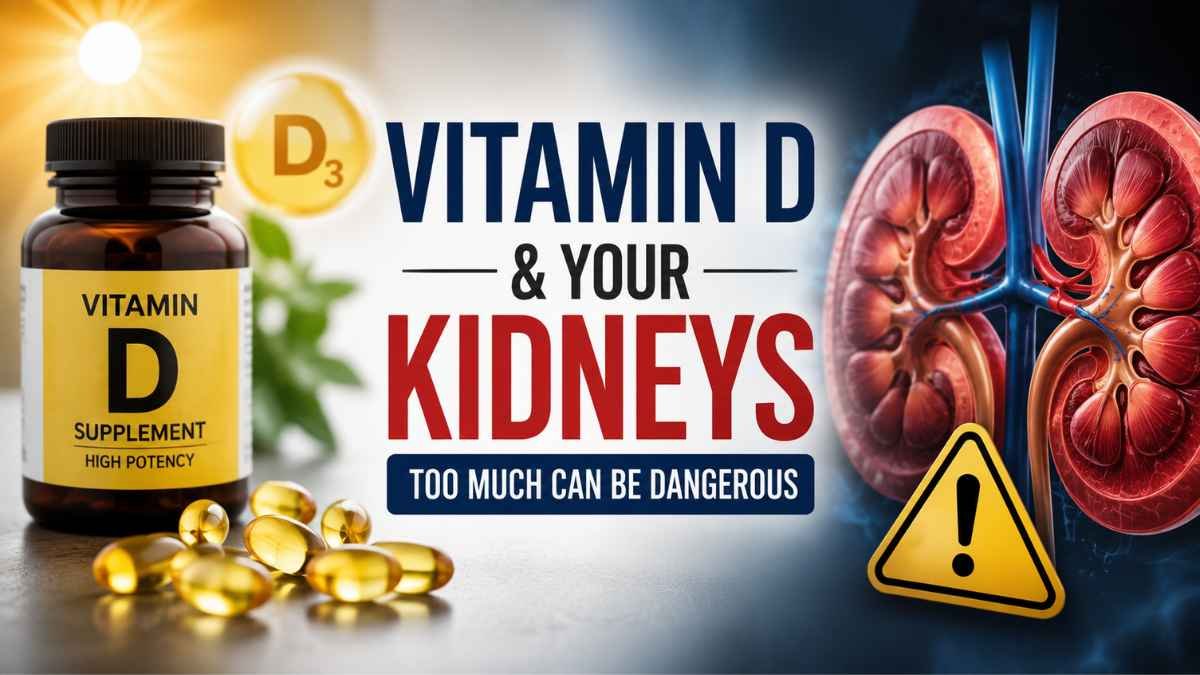
Vitamin D is often called the “sunshine vitamin”, and for good reason. It plays an important role in calcium absorption, bone health and normal calcium metabolism.
But there is a side of vitamin D that receives far less attention.
Taking too much vitamin D from supplements can become dangerous.
In severe cases, excessive vitamin D can cause a major rise in blood calcium levels, leading to dehydration, kidney stones and, in rare cases, acute kidney injury or renal failure.
That does not mean vitamin D itself is bad for the kidneys.
The problem is excessive supplementation, particularly when high doses are taken for long periods without medical supervision.
How can too much vitamin D affect the kidneys?
To understand the connection between vitamin D toxicity and kidney failure, it helps to understand what vitamin D does in the body.
One of vitamin D's important functions is helping the intestine absorb calcium.
When vitamin D levels become excessively high, calcium absorption can increase significantly. This can lead to hypercalcemia, meaning there is too much calcium in the blood.
According to the NIH, vitamin D toxicity can cause hypercalcemia and hypercalciuria. In severe cases, the resulting complications can include kidney stones, kidney damage and renal failure.
The chain can look like this:
Too much vitamin D
↓
More calcium absorbed
↓
Calcium levels rise too high
↓
Hypercalcemia + dehydration
↓
Kidneys become stressed or injured
↓
Acute kidney injury in severe cases
This is the key connection between excess vitamin D and kidney problems.
Vitamin D itself is not the enemy
This distinction is extremely important.
Vitamin D is an essential nutrient, and the body needs it.
The recommended dietary allowance for adults aged 19–70 is 600 IU per day, while adults over 70 generally need 800 IU per day. These recommendations include vitamin D obtained from food and supplements.
The problem begins when people assume:
“If a little vitamin D is good, more must be better.”
That logic does not work with vitamins.
More is not always better.
How much vitamin D is too much?
For healthy adults, the NIH lists 4,000 IU per day as the tolerable upper intake level for vitamin D from all sources. The upper limit is different for younger age groups.
But there is an important caveat.
A doctor may prescribe a higher dose temporarily to treat a documented vitamin D deficiency. That does not mean someone should independently take high-dose vitamin D every day.
The problem is particularly concerning when people start taking large doses on their own and continue them for months.
Some reported cases of vitamin D toxicity involved prolonged use of very high-dose supplements.
So the question shouldn't simply be:
“How many IU does this capsule contain?”
It should also be:
“Do I actually need this dose, and for how long?”
Why are high-dose vitamin D capsules risky?
Vitamin D is fat-soluble, meaning the body handles it differently from water-soluble vitamins.
Excessive intake can lead to elevated vitamin D levels and, more importantly, excessive calcium absorption.
The resulting high calcium levels can produce symptoms such as:
- Nausea
- Vomiting
- Poor appetite
- Muscle weakness
- Confusion
- Excessive thirst
- Frequent urination
- Dehydration
- Kidney stones
These symptoms are recognized signs associated with excessive vitamin D intake and toxicity.
And this is where the kidneys become particularly important.
What does high calcium do to the kidneys?
The kidneys have to filter the blood and regulate fluids and minerals.
When calcium levels become severely elevated, several things can happen.
Excess calcium can contribute to dehydration and increased urination. Severe hypercalcemia can also reduce kidney function.
Vitamin D toxicity has been associated with acute kidney injury, nephrocalcinosis and renal impairment in published case reports.
In other words, the kidney damage is usually not because vitamin D directly “burns” or destroys the kidneys.
It is often the result of the metabolic consequences of vitamin D toxicity, especially severe hypercalcemia.
Can vitamin D really cause kidney failure?
In severe cases, yes—but it is rare.
The NIH specifically states that extreme vitamin D toxicity can cause renal failure.
Medical literature also contains documented cases of acute kidney injury associated with excessive vitamin D supplementation.
For example, a 2025 case report described a previously healthy man who developed severe hypercalcemia and acute renal failure after using highly concentrated over-the-counter vitamin D supplements for six months. Kidney biopsy showed nephrocalcinosis.
Another published case involved a patient taking very high doses of vitamin D for years who developed severe hypercalcemia and acute kidney injury.
These cases are uncommon, but they demonstrate an important point:
A vitamin supplement is not automatically harmless simply because it is sold over the counter.
The danger of taking multiple supplements
There is another problem people often overlook.
Someone may take a vitamin D capsule every day while also taking:
- A multivitamin
- Calcium supplements
- Bone-health supplements
- Certain fortified foods
- Other products containing vitamin D
The total intake can therefore be higher than expected.
The NIH upper intake level applies to vitamin D from all sources, including food, beverages and supplements.
And taking calcium together with vitamin D can increase the risk of certain adverse effects in some circumstances.
This is why checking the complete supplement routine matters.
What if someone takes 10,000 IU of vitamin D every day?
This is an important example because high-dose vitamin D products are widely available.
For healthy adults, 10,000 IU per day is above the NIH's 4,000 IU/day tolerable upper intake level.
However, this does not mean that one dose of 10,000 IU will suddenly cause kidney failure.
Vitamin D toxicity generally develops from excessive intake over time, although the exact risk depends on the individual, the duration, other supplements and medical conditions.
There are published cases of people taking thousands or tens of thousands of IU daily for prolonged periods and developing hypercalcemia and kidney injury.
So taking a high-dose capsule every day simply because it is available is not a good idea without medical guidance.
What symptoms should you watch for?
One reason vitamin D toxicity can be missed is that its early symptoms can be nonspecific.
Someone may think they are simply tired or dehydrated.
Possible symptoms of excessive vitamin D include:
Excessive thirst
The person may feel unusually thirsty.
Frequent urination
High calcium levels can affect the kidneys' ability to concentrate urine.
Nausea or vomiting
Digestive symptoms can occur with hypercalcemia.
Loss of appetite
A sudden reduction in appetite can occur.
Muscle weakness
Excess calcium can affect normal muscle and nerve function.
Confusion
Severe hypercalcemia can affect the nervous system.
Dehydration
Increased urination and fluid loss can make dehydration worse.
If these symptoms occur in someone taking high-dose vitamin D, they should not simply continue the supplement and wait for the problem to disappear.
Medical evaluation may be necessary.
What happens if someone already has kidney disease?
This is an especially important issue.
The kidneys play a major role in vitamin D metabolism and calcium regulation.
People with chronic kidney disease can have abnormal mineral and vitamin D metabolism, and their supplementation may need to be managed differently.
The National Kidney Foundation notes that people with advanced chronic kidney disease may have difficulty activating vitamin D and may require a specific form of vitamin D prescribed by a healthcare professional.
That means someone with kidney disease should not automatically follow a high-dose vitamin D routine designed for someone else.
The appropriate form and dose can depend on kidney function, calcium, phosphorus, parathyroid hormone and vitamin D status.
What about vitamin D and kidney stones?
Kidney stones are another potential concern.
Excess vitamin D can increase calcium absorption and contribute to elevated calcium levels. The NIH lists kidney stones among the potential consequences of excessive vitamin D intake.
The National Kidney Foundation also advises people with a history of kidney stones to discuss vitamin D and other mineral supplements with a healthcare professional because some supplements may increase stone risk in susceptible individuals.
This does not mean that normal vitamin D intake automatically causes kidney stones.
Again, dose and individual risk matter.
Can you get too much vitamin D from sunlight?
This is another common misconception.
Normally, your body regulates vitamin D production from sunlight, so sunlight itself does not generally cause vitamin D toxicity.
The bigger concern is excessive vitamin D intake from supplements. NIH states that vitamin D toxicity is almost always caused by excessive intake from supplements rather than sunlight.
So taking more capsules is not a substitute for understanding whether you actually have a deficiency.
Should everyone take vitamin D supplements?
No.
Some people may genuinely need vitamin D supplementation, particularly when deficiency has been diagnosed or when a healthcare professional identifies a specific reason for supplementation.
But taking vitamin D simply because it is considered a “healthy vitamin” is a different situation.
The appropriate dose depends on factors such as:
- Age
- Diet
- Sun exposure
- Vitamin D status
- Medical conditions
- Kidney function
- Other medications
- Other supplements
A blood test may be used by a healthcare professional to assess vitamin D status when clinically appropriate.
Why blood tests matter
Vitamin D deficiency and vitamin D toxicity are two very different problems.
Someone who is deficient may require supplementation.
Someone who already has adequate levels may not benefit from taking increasingly large doses.
And someone taking very high doses for a long period may develop excessive vitamin D levels and hypercalcemia.
That is why testing and medical supervision can be important when high-dose supplementation is being considered, rather than simply increasing the dose based on symptoms or internet advice.
The biggest mistake: “It's only a vitamin”
The word “vitamin” can make supplements sound completely harmless.
But vitamins are biologically active substances.
The body needs them in appropriate amounts.
Too little can cause problems.
Too much can also cause problems.
Vitamin D is a particularly good example.
A normal amount supports calcium balance and bone health.
An excessive amount can push calcium levels too high and, in severe cases, damage the kidneys.
The Bottom Line
Vitamin D is important—but more vitamin D is not necessarily better.
Normal vitamin D intake does not mean that a person is at risk of kidney failure. The concern arises when people take excessive doses of vitamin D supplements, especially for prolonged periods without medical supervision.
Too much vitamin D can cause hypercalcemia, which may lead to excessive thirst, frequent urination, dehydration, kidney stones and, in severe cases, acute kidney injury or renal failure.
For healthy adults, the NIH lists 4,000 IU per day as the tolerable upper intake level, while routine recommended intake is generally much lower—600 IU per day for adults up to age 70 and 800 IU for those over 70.
Doctors may prescribe higher doses for specific medical reasons, so the upper limit should not be interpreted as a treatment rule.
The safest approach is simple:
Don't take high-dose vitamin D capsules just because you think more will give you more health benefits.
If you are taking a high-dose supplement regularly, especially if you have kidney problems or are also taking calcium supplements, discuss the dose with a healthcare professional.
Because when it comes to vitamin D, the goal isn't to have as much as possible—the goal is to have the right amount.Vitamin D is often called the “sunshine vitamin”, and for good reason. It plays an important role in calcium absorption, bone health and normal calcium metabolism.
But there is a side of vitamin D that receives far less attention.
Taking too much vitamin D from supplements can become dangerous.
In severe cases, excessive vitamin D can cause a major rise in blood calcium levels, leading to dehydration, kidney stones and, in rare cases, acute kidney injury or renal failure.
That does not mean vitamin D itself is bad for the kidneys.
The problem is excessive supplementation, particularly when high doses are taken for long periods without medical supervision.
How can too much vitamin D affect the kidneys?
To understand the connection between vitamin D toxicity and kidney failure, it helps to understand what vitamin D does in the body.
One of vitamin D's important functions is helping the intestine absorb calcium.
When vitamin D levels become excessively high, calcium absorption can increase significantly. This can lead to hypercalcemia, meaning there is too much calcium in the blood.
According to the NIH, vitamin D toxicity can cause hypercalcemia and hypercalciuria. In severe cases, the resulting complications can include kidney stones, kidney damage and renal failure.
The chain can look like this:
Too much vitamin D
↓
More calcium absorbed
↓
Calcium levels rise too high
↓
Hypercalcemia + dehydration
↓
Kidneys become stressed or injured
↓
Acute kidney injury in severe cases
This is the key connection between excess vitamin D and kidney problems.
Vitamin D itself is not the enemy
This distinction is extremely important.
Vitamin D is an essential nutrient, and the body needs it.
The recommended dietary allowance for adults aged 19–70 is 600 IU per day, while adults over 70 generally need 800 IU per day. These recommendations include vitamin D obtained from food and supplements.
The problem begins when people assume:
“If a little vitamin D is good, more must be better.”
That logic does not work with vitamins.
More is not always better.
How much vitamin D is too much?
For healthy adults, the NIH lists 4,000 IU per day as the tolerable upper intake level for vitamin D from all sources. The upper limit is different for younger age groups.
But there is an important caveat.
A doctor may prescribe a higher dose temporarily to treat a documented vitamin D deficiency. That does not mean someone should independently take high-dose vitamin D every day.
The problem is particularly concerning when people start taking large doses on their own and continue them for months.
Some reported cases of vitamin D toxicity involved prolonged use of very high-dose supplements.
So the question shouldn't simply be:
“How many IU does this capsule contain?”
It should also be:
“Do I actually need this dose, and for how long?”
Why are high-dose vitamin D capsules risky?
Vitamin D is fat-soluble, meaning the body handles it differently from water-soluble vitamins.
Excessive intake can lead to elevated vitamin D levels and, more importantly, excessive calcium absorption.
The resulting high calcium levels can produce symptoms such as:
- Nausea
- Vomiting
- Poor appetite
- Muscle weakness
- Confusion
- Excessive thirst
- Frequent urination
- Dehydration
- Kidney stones
These symptoms are recognized signs associated with excessive vitamin D intake and toxicity.
And this is where the kidneys become particularly important.
What does high calcium do to the kidneys?
The kidneys have to filter the blood and regulate fluids and minerals.
When calcium levels become severely elevated, several things can happen.
Excess calcium can contribute to dehydration and increased urination. Severe hypercalcemia can also reduce kidney function.
Vitamin D toxicity has been associated with acute kidney injury, nephrocalcinosis and renal impairment in published case reports.
In other words, the kidney damage is usually not because vitamin D directly “burns” or destroys the kidneys.
It is often the result of the metabolic consequences of vitamin D toxicity, especially severe hypercalcemia.
Can vitamin D really cause kidney failure?
In severe cases, yes—but it is rare.
The NIH specifically states that extreme vitamin D toxicity can cause renal failure.
Medical literature also contains documented cases of acute kidney injury associated with excessive vitamin D supplementation.
For example, a 2025 case report described a previously healthy man who developed severe hypercalcemia and acute renal failure after using highly concentrated over-the-counter vitamin D supplements for six months. Kidney biopsy showed nephrocalcinosis.
Another published case involved a patient taking very high doses of vitamin D for years who developed severe hypercalcemia and acute kidney injury.
These cases are uncommon, but they demonstrate an important point:
A vitamin supplement is not automatically harmless simply because it is sold over the counter.
The danger of taking multiple supplements
There is another problem people often overlook.
Someone may take a vitamin D capsule every day while also taking:
- A multivitamin
- Calcium supplements
- Bone-health supplements
- Certain fortified foods
- Other products containing vitamin D
The total intake can therefore be higher than expected.
The NIH upper intake level applies to vitamin D from all sources, including food, beverages and supplements.
And taking calcium together with vitamin D can increase the risk of certain adverse effects in some circumstances.
This is why checking the complete supplement routine matters.
What if someone takes 10,000 IU of vitamin D every day?
This is an important example because high-dose vitamin D products are widely available.
For healthy adults, 10,000 IU per day is above the NIH's 4,000 IU/day tolerable upper intake level.
However, this does not mean that one dose of 10,000 IU will suddenly cause kidney failure.
Vitamin D toxicity generally develops from excessive intake over time, although the exact risk depends on the individual, the duration, other supplements and medical conditions.
There are published cases of people taking thousands or tens of thousands of IU daily for prolonged periods and developing hypercalcemia and kidney injury.
So taking a high-dose capsule every day simply because it is available is not a good idea without medical guidance.
What symptoms should you watch for?
One reason vitamin D toxicity can be missed is that its early symptoms can be nonspecific.
Someone may think they are simply tired or dehydrated.
Possible symptoms of excessive vitamin D include:
Excessive thirst
The person may feel unusually thirsty.
Frequent urination
High calcium levels can affect the kidneys' ability to concentrate urine.
Nausea or vomiting
Digestive symptoms can occur with hypercalcemia.
Loss of appetite
A sudden reduction in appetite can occur.
Muscle weakness
Excess calcium can affect normal muscle and nerve function.
Confusion
Severe hypercalcemia can affect the nervous system.
Dehydration
Increased urination and fluid loss can make dehydration worse.
If these symptoms occur in someone taking high-dose vitamin D, they should not simply continue the supplement and wait for the problem to disappear.
Medical evaluation may be necessary.
What happens if someone already has kidney disease?
This is an especially important issue.
The kidneys play a major role in vitamin D metabolism and calcium regulation.
People with chronic kidney disease can have abnormal mineral and vitamin D metabolism, and their supplementation may need to be managed differently.
The National Kidney Foundation notes that people with advanced chronic kidney disease may have difficulty activating vitamin D and may require a specific form of vitamin D prescribed by a healthcare professional.
That means someone with kidney disease should not automatically follow a high-dose vitamin D routine designed for someone else.
The appropriate form and dose can depend on kidney function, calcium, phosphorus, parathyroid hormone and vitamin D status.
What about vitamin D and kidney stones?
Kidney stones are another potential concern.
Excess vitamin D can increase calcium absorption and contribute to elevated calcium levels. The NIH lists kidney stones among the potential consequences of excessive vitamin D intake.
The National Kidney Foundation also advises people with a history of kidney stones to discuss vitamin D and other mineral supplements with a healthcare professional because some supplements may increase stone risk in susceptible individuals.
This does not mean that normal vitamin D intake automatically causes kidney stones.
Again, dose and individual risk matter.
Can you get too much vitamin D from sunlight?
This is another common misconception.
Normally, your body regulates vitamin D production from sunlight, so sunlight itself does not generally cause vitamin D toxicity.
The bigger concern is excessive vitamin D intake from supplements. NIH states that vitamin D toxicity is almost always caused by excessive intake from supplements rather than sunlight.
So taking more capsules is not a substitute for understanding whether you actually have a deficiency.
Should everyone take vitamin D supplements?
No.
Some people may genuinely need vitamin D supplementation, particularly when deficiency has been diagnosed or when a healthcare professional identifies a specific reason for supplementation.
But taking vitamin D simply because it is considered a “healthy vitamin” is a different situation.
The appropriate dose depends on factors such as:
- Age
- Diet
- Sun exposure
- Vitamin D status
- Medical conditions
- Kidney function
- Other medications
- Other supplements
A blood test may be used by a healthcare professional to assess vitamin D status when clinically appropriate.
Why blood tests matter
Vitamin D deficiency and vitamin D toxicity are two very different problems.
Someone who is deficient may require supplementation.
Someone who already has adequate levels may not benefit from taking increasingly large doses.
And someone taking very high doses for a long period may develop excessive vitamin D levels and hypercalcemia.
That is why testing and medical supervision can be important when high-dose supplementation is being considered, rather than simply increasing the dose based on symptoms or internet advice.
The biggest mistake: “It's only a vitamin”
The word “vitamin” can make supplements sound completely harmless.
But vitamins are biologically active substances.
The body needs them in appropriate amounts.
Too little can cause problems.
Too much can also cause problems.
Vitamin D is a particularly good example.
A normal amount supports calcium balance and bone health.
An excessive amount can push calcium levels too high and, in severe cases, damage the kidneys.
The Bottom Line
Vitamin D is important—but more vitamin D is not necessarily better.
Normal vitamin D intake does not mean that a person is at risk of kidney failure. The concern arises when people take excessive doses of vitamin D supplements, especially for prolonged periods without medical supervision.
Too much vitamin D can cause hypercalcemia, which may lead to excessive thirst, frequent urination, dehydration, kidney stones and, in severe cases, acute kidney injury or renal failure.
For healthy adults, the NIH lists 4,000 IU per day as the tolerable upper intake level, while routine recommended intake is generally much lower—600 IU per day for adults up to age 70 and 800 IU for those over 70.
Doctors may prescribe higher doses for specific medical reasons, so the upper limit should not be interpreted as a treatment rule.
The safest approach is simple:
Don't take high-dose vitamin D capsules just because you think more will give you more health benefits.
If you are taking a high-dose supplement regularly, especially if you have kidney problems or are also taking calcium supplements, discuss the dose with a healthcare professional.
Because when it comes to vitamin D, the goal isn't to have as much as possible—the goal is to have the right amount.