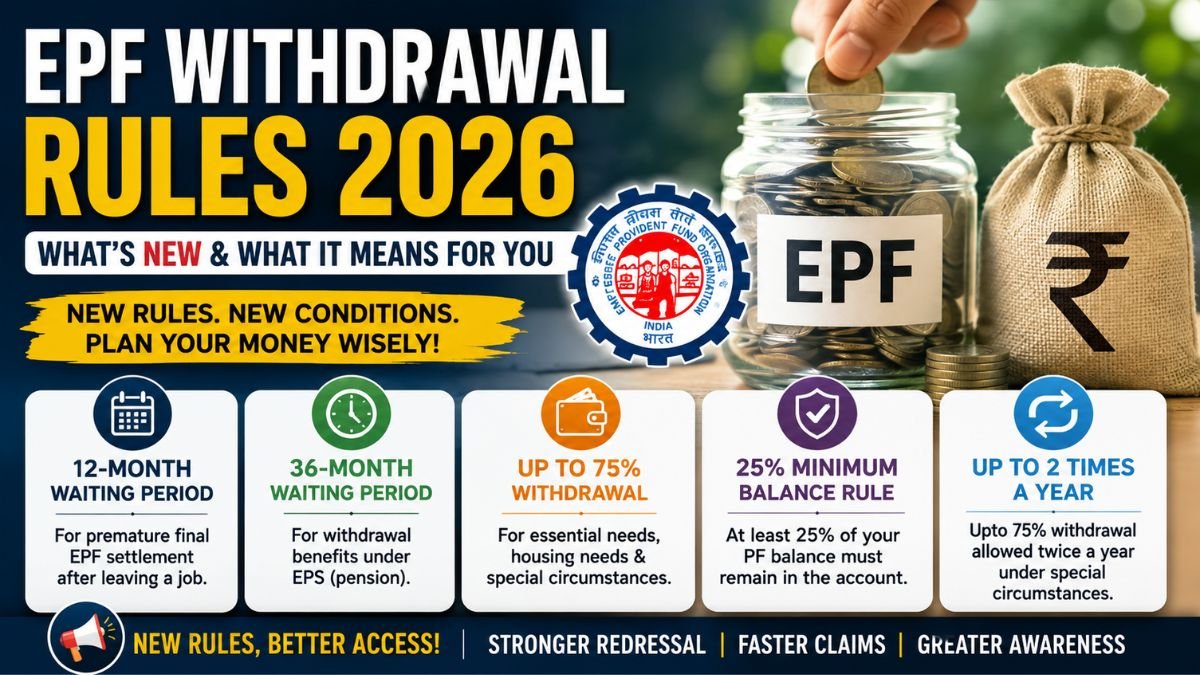
If you are planning to withdraw money from your EPF account after leaving a job, the rules have changed. Under the new EPF Scheme 2026, members face a 12-month waiting period for premature final EPF settlement, while withdrawal benefits under the Employees' Pension Scheme (EPS) now have a 36-month waiting period, subject to applicable conditions.
The government clarified the new rules in a written reply to the Lok Sabha on August 10. Minister of State for Labour and Employment Shobha Karandlaje explained that although final settlement has a longer waiting period, EPFO members can still access a substantial part of their PF savings through simplified partial-withdrawal provisions.
You Can't Simply Withdraw the Entire EPF Balance Immediately
Under the revised framework, employees who leave employment cannot immediately take out their entire EPF balance.
The government has introduced a 12-month waiting period for premature final EPF settlement. This is different from the earlier system under which members could make a final settlement after a shorter period of unemployment.
The new rule is aimed at keeping more retirement savings invested for longer while still allowing members to access money when they have specific financial needs.
For employees wondering when they can withdraw their full PF after leaving a job, the 12-month waiting period is now an important part of the EPF Scheme 2026 framework.
But You Can Still Access Up to 75% of Your PF
The longer wait for final settlement does not mean that your entire EPF balance becomes inaccessible.
The government says EPFO has simultaneously liberalised and simplified partial withdrawals and advances.
Members can access up to 75% of their PF balance under three broad categories:
- Essential needs
- Housing needs
- Special circumstances
These provisions cover situations including unemployment-related expenses, medical emergencies, education, housing and other critical requirements.
This means an employee who needs money before becoming eligible for complete settlement can still use a significant portion of the accumulated PF balance, provided the withdrawal meets the applicable conditions.
The 25% Minimum Balance Rule
One of the key changes under the new EPF framework is the requirement to retain a portion of the PF savings instead of allowing the entire balance to be withdrawn through partial withdrawals.
The revised framework includes a 25% minimum balance requirement, meaning members are expected to keep at least 25% of their PF balance in the account.
The idea is to ensure that employees do not completely exhaust their retirement savings while using EPF money for immediate financial requirements.
So, if you are looking at the new EPF withdrawal rules 2026, the basic picture is that a member may access a substantial portion of the balance, but the framework also protects a portion of the retirement corpus.
Special Circumstances Allow Two Withdrawals a Year
There is another provision that gives members additional flexibility.
According to the government's clarification, members can avail themselves of 75% of their balance up to two times a year under special circumstances without assigning any reason.
This is separate from the longer waiting period for premature final settlement.
The government has therefore attempted to balance two objectives: allowing workers to access their PF savings when they need them while preventing premature withdrawal of the entire retirement corpus.
What Happens to EPS Withdrawal?
The new rules also affect the Employees' Pension Scheme (EPS).
According to the government's Lok Sabha reply, members seeking withdrawal benefits under EPS will have to observe a 36-month waiting period, subject to the applicable conditions.
This is separate from the 12-month waiting period applicable to premature final EPF settlement.
The government was specifically asked about concerns surrounding the new withdrawal restrictions, including the minimum balance requirement and the longer EPS waiting period.
Why Were These EPF Rules Changed?
The changes were introduced as part of the EPF Scheme 2026 and have raised questions among employees about access to their retirement savings.
The government said the amendments were discussed through the Central Board of Trustees (CBT), EPF, which includes representatives of recognised trade unions, employer associations, and the Central and State governments.
The amendments were placed before the 238th meeting of the CBT, where they were discussed before being recommended to the government for notification.
The government has also stressed that the new system simplifies several partial-withdrawal provisions even as it introduces longer waiting periods for final settlement and EPS withdrawal benefits.
EPFO to Strengthen Grievance Redressal
The government was also questioned about how EPFO would deal with financial hardship and implementation-related problems created by the revised withdrawal rules.
In response, the Labour Ministry highlighted measures including:
- Stronger grievance redressal
- Greater outreach and awareness about the new rules
- Digital claim settlement
- Faster processing and disbursal of admissible advances
These measures are intended to help members understand the new EPF withdrawal rules 2026 and receive eligible advances without unnecessary delays.
What the New EPF Rules Mean for Employees
The biggest change is that full EPF settlement after leaving employment is no longer immediately available under the new 12-month waiting period.
At the same time, employees are not completely locked out of their PF savings. The revised system allows withdrawals for essential needs, housing and special circumstances, with members able to access up to 75% under the applicable provisions.
The new framework also introduces the 25% minimum balance requirement, while EPS withdrawal benefits come with a 36-month waiting period.
For employees, the practical takeaway is simple: you can still access a substantial portion of your PF money when eligible, but withdrawing the entire retirement corpus has become more restrictive.