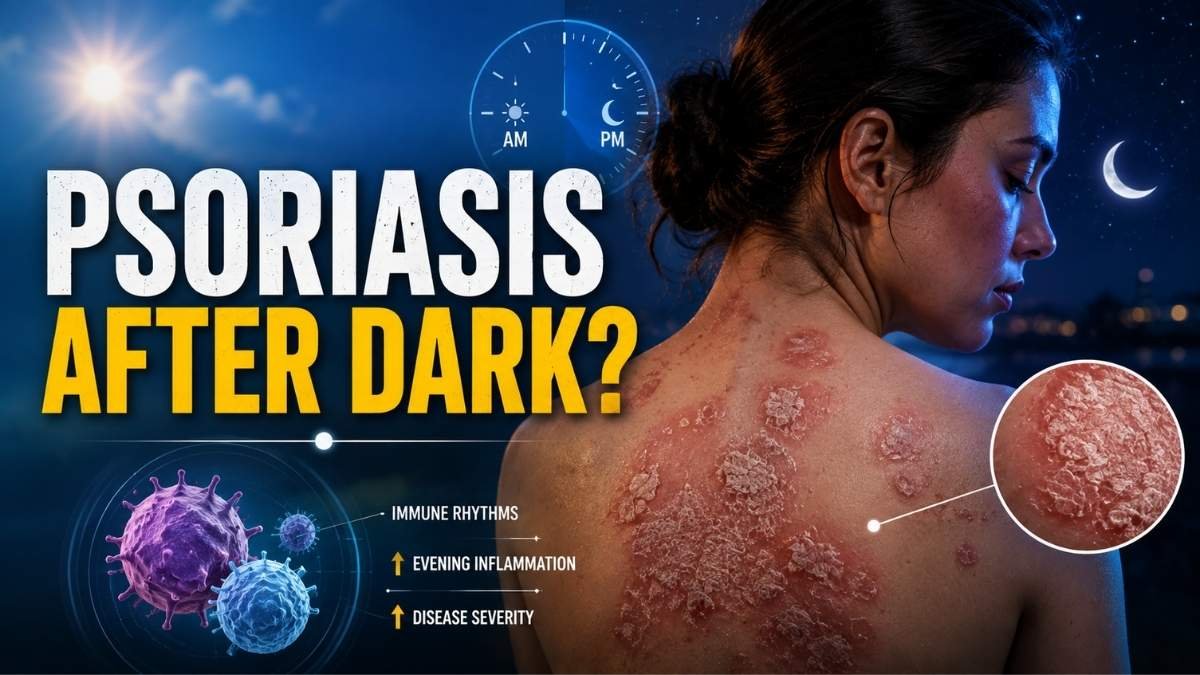
Psoriasis is usually thought of as a chronic skin condition that causes symptoms such as inflammation and irritation. But new research suggests that psoriasis may also have a time-of-day pattern, with changes in the immune system appearing to be linked to how severe the disease becomes.
A new study found that people with psoriasis had disrupted daily immune rhythms, particularly later in the day. The researchers also found that stronger evening inflammatory activity was associated with greater disease severity and poorer treatment response.
The findings could help researchers better understand why psoriasis symptoms may worsen later in the day and whether the timing of immune activity could eventually become useful when evaluating treatment response.
Why Does Psoriasis Appear to Change During the Day?
Psoriasis is a chronic inflammatory skin disease, and daily changes in symptoms have already been observed clinically.
However, researchers have not fully understood what drives these fluctuations.
To investigate the connection between psoriasis and the body's internal immune rhythms, researchers collected blood samples from people with psoriasis at two different times: morning and evening.
Samples were collected both before and after treatment with anti-IL-23 therapy.
The researchers measured different immune-cell populations as well as molecules involved in inflammation, including cytokines and chemokines. They also analysed publicly available gene-expression data from psoriatic skin to investigate whether inflammatory activity in the skin changed depending on the time of day.
Evening Inflammation Was Linked to More Severe Psoriasis
One of the study's major findings was that people with psoriasis showed less variation in circulating lymphocytes throughout the day.
This was largely driven by lower lymphocyte counts during the evening.
At the same time, the researchers observed an evening-biased inflammatory profile. This included increased levels of cytokines and chemokines involved in inflammation and the movement of immune cells.
The researchers also found that the degree of daily immune variation was connected with psoriasis disease severity.
In particular, changes in interleukin-31 (IL-31) over the course of the day were positively associated with Psoriasis Area and Severity Index (PASI) scores.
In contrast, time-dependent changes involving T helper 17 (Th17) cells and the CD4-positive to CD8-positive ratio showed negative correlations with disease severity.
This suggests that the immune system's daily pattern may provide additional information about how active or severe psoriasis is.
Treatment Responders and Non-Responders Looked Different
The study also found differences between people who responded to treatment and those who did not.
Patients who did not respond to treatment had higher levels of evening interleukin-31 before treatment.
They also showed a more pro-inflammatory immune profile compared with people who responded to therapy.
This finding is particularly interesting because it suggests that the timing of inflammatory activity could potentially provide information about psoriasis treatment response.
However, the study does not establish that measuring these immune rhythms can currently be used as a routine clinical test.
Anti-IL-23 Therapy Partially Restored Immune Rhythms
The researchers then examined what happened after patients received anti-IL-23 therapy.
Treatment reduced levels of inflammatory mediators and partially restored the disrupted daily immune patterns, particularly during the evening.
The skin analysis showed a similar pattern.
Before treatment, researchers found increased late-day inflammatory activity and immune-cell infiltration in psoriatic skin. These changes were reduced following therapy.
The findings therefore suggest that successful treatment may not only reduce inflammation overall but may also help restore some of the body's disrupted time-of-day immune regulation.
Could the Time of Day Help Doctors Understand Psoriasis Better?
The researchers believe that considering when immune activity is measured could become important when interpreting inflammatory biomarkers.
A blood sample taken in the morning may not show exactly the same immune profile as one taken in the evening.
If immune markers naturally fluctuate throughout the day—and those fluctuations are associated with psoriasis severity and treatment response—then the timing of a measurement could potentially influence how the result is interpreted.
The researchers suggested that incorporating this temporal immune context into biomarker assessment could improve interpretation of inflammatory markers and potentially inform future treatment strategies.
The study does not mean that psoriasis is simply caused by the time of day. Instead, it points toward a more complex relationship between the immune system's daily rhythms, inflammation and psoriasis activity.
What the Study Could Mean for Future Psoriasis Treatment
The findings add another layer to understanding psoriasis.
Rather than looking only at how much inflammation is present, future research may also need to consider when inflammatory activity is highest.
The study found that evening immune changes were particularly noticeable in psoriasis and that these patterns were associated with disease severity. Anti-IL-23 treatment partially restored the disrupted immune rhythms, suggesting that treatment response may also be connected with changes in these daily immune patterns.
The researchers concluded that psoriasis is characterised by disrupted time-of-day immune regulation and that these changes are associated with both disease severity and therapeutic response.
The study was published in the British Journal of Dermatology under the title “Time-of-day-dependent immune dynamics are associated with disease severity and therapeutic response in psoriasis.