A political phrase used by Prime Minister Narendra Modi during his Independence Day speech has taken an unexpected turn on social media.
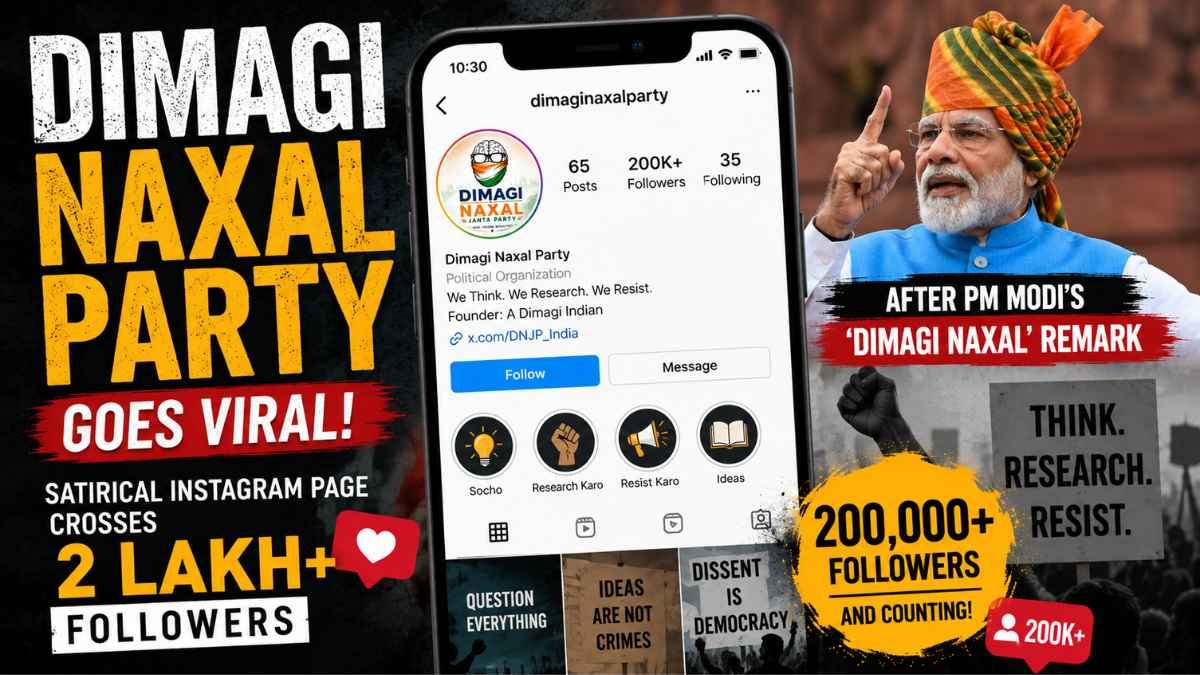
Within a day of Modi using the term “dimagi Naxal”, an Instagram account calling itself the Dimagi Naxal Party appeared online. What happened next was remarkably fast: the satirical page reportedly gained more than 181,000 followers overnight and crossed 200,000 followers by Monday afternoon.
The account does not present itself like a conventional political party. Instead, it describes itself as an online satirical movement, using political language, internet culture and humour to build an audience.
It Started With a Political Label
The story began with Modi's Independence Day speech from the Red Fort.
While speaking about India's fight against armed Maoist insurgency, the Prime Minister argued that the problem had changed form and referred to people influenced by what he described as a Maoist mindset.
His remarks triggered a political debate over the meaning and use of the phrase “dimagi Naxal.”
Soon afterwards, someone created the Dimagi Naxal Party Instagram account.
The timing was difficult to miss.
From Instagram Account to Viral Movement
The account's growth was almost instantaneous.
According to the report, it gained more than 181,000 followers overnight. By Monday afternoon, the number had passed 200,000.
Several other accounts using similar names also appeared across social media as the original page attracted attention.
Users began sharing the account through Instagram Stories and reposts, with some encouraging others to follow it before it could potentially disappear.
That helped create a classic social-media feedback loop:
Political controversy → viral phrase → satirical account → reposts → rapidly increasing followers.
The Party's First Rule Is Probably Its Biggest Joke
One of the account's earliest posts offered a supposed set of membership criteria.
At the top of the list was an unusual condition:
You must be able to disagree with your own leaders.
That immediately establishes what kind of “party” this is.
Rather than presenting a conventional political manifesto, the account uses satire to question political loyalty, authority and the tendency to blindly follow leaders.
Its stated slogan is:
“We think. We research. We resist.”
Nobody Knows Who Is Behind It
Despite its sudden popularity, the people operating the account remain unknown.
The Instagram bio reportedly identifies its founder simply as “a dimagi Indian.”
There is no confirmed information establishing the identity of the person or group behind the page.
That anonymity has arguably added another layer of curiosity.
The account gained hundreds of thousands of followers before the public even knew who was running it.
Then the Account Suddenly Became Unavailable
The story became even more unusual when the Instagram page briefly became inaccessible.
The account's operators later claimed on X that they were facing cyberattacks. That claim has not been independently established by the report.
The disappearance only added to the online attention.
Some users began urging others to follow the page quickly, apparently fearing that it could be taken down.
That kind of reaction can itself accelerate the growth of an online account.
Why Bhagat Singh Appears in Its Messaging
The Dimagi Naxal Party has also attempted to frame its identity around Bhagat Singh.
Posts from the account say that it follows Bhagat Singh's ideology. One post argued that attempts to suspend the account or label its members as anti-national would amount to disrespecting the freedom fighter.
The use of Bhagat Singh is significant because the account is presenting ideas such as questioning authority and resisting established systems as part of its identity.
George Orwell's 1984 Also Enters the Picture
The account has gone beyond Indian political references.
Its posts have drawn comparisons between the phrase “dimagi Naxal” and the concept of thought crime from George Orwell's 1984.
That gives the account another layer of messaging.
Instead of accepting the political label at face value, the page attempts to reinterpret it as an identity connected with questioning systems and recognising patterns of power.
Whether that interpretation lasts is another question, but it has clearly helped the account create a distinct online personality.
P. Chidambaram Adds Fuel to the Debate
The Instagram account's growth came as politicians themselves were debating the phrase.
Congress leader P. Chidambaram responded to Modi's remarks by saying that he was “proud to be a dimagi naxal.”
His comment further amplified the phrase online.
Union Minister Kiren Rijiju, however, rejected the interpretation that Modi was simply referring to opposition leaders. He said the term was meant for people supporting Maoist ideology, separatism or positions that the government considers contrary to India's constitutional framework.
BJP MP Ravi Shankar Prasad also criticised Chidambaram's response.
This Is Bigger Than One Instagram Page
The interesting part of the story isn't simply that an Instagram account gained 200,000 followers.
It is how quickly a political label was transformed into an online identity.
Political language has always been repurposed through satire, memes and popular culture. Social media makes that process dramatically faster.
A phrase spoken in a political speech can become a hashtag, a joke, a profile name and eventually a community within hours.
That appears to be what has happened with the Dimagi Naxal Party.
The Cockroach Janta Party Connection
The phenomenon also resembles the rise of the Cockroach Janta Party, another social-media-driven satirical movement.
The Telegraph India report notes that CJP has already amassed more than 26 million Instagram followers, demonstrating how political satire can develop into a large online brand.
The Dimagi Naxal Party is obviously much smaller at the moment.
But its speed of growth is what makes the story notable.
Crossing 200,000 followers within days is difficult to achieve for a completely new account under normal circumstances.
Is Dimagi Naxal Party an Actual Political Party?
No evidence in the report suggests that it is a formally registered political party.
It is better understood as a satirical social-media movement using the language of politics.
The word “party” is part of its online identity rather than proof that it has become an established political organisation.
Why Did It Grow So Fast?
There are several obvious ingredients behind the sudden rise:
- A controversial political phrase
- A major national speech
- Instant social-media relevance
- Satirical branding
- A simple and memorable name
- Political debate surrounding the phrase
- Users sharing the account across platforms
- Curiosity about who operates it
Put together, those factors created almost perfect conditions for a viral social-media account.
The Bigger Social Media Lesson
The Dimagi Naxal Party story shows how difficult it has become to control the meaning of political language once it enters the internet.
A phrase intended to describe one political idea can be reinterpreted, mocked, adopted or turned into a brand by the very audience discussing it.
In this case, a term from a political speech became the name of an Instagram account—and that account then attracted more than 200,000 followers in a matter of days.
Whether the movement survives beyond the current controversy remains to be seen.
But for now, “Dimagi Naxal” has become more than a political phrase. It has become an unexpected piece of India's social-media culture.