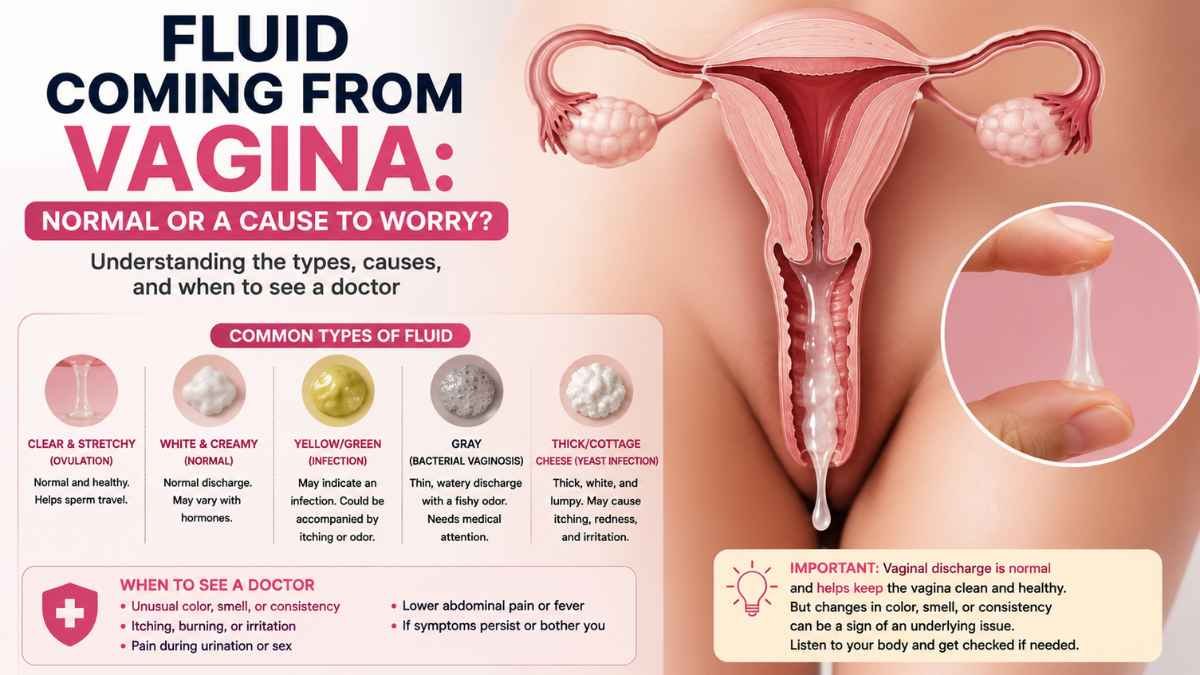
Fluid coming from the vagina is something almost every woman notices at some point. Sometimes it is clear and watery, sometimes white and creamy, and around ovulation it can become slippery and stretchy.
In many cases, this fluid is completely normal.
Vaginal discharge is actually one of the body's natural ways of keeping the vagina healthy. Its amount, texture and appearance can change throughout the menstrual cycle because of hormones.
However, a sudden change in color, smell, consistency or amount, especially when accompanied by itching, burning or pain, can sometimes indicate an infection or another health problem.
So, vaginal fluid is not automatically a sign of disease. The important thing is understanding what is normal for you.
What is vaginal discharge?
Vaginal discharge is fluid or mucus produced by the cervix and vaginal tissues.
It helps maintain the vagina's normal environment and can remove dead cells and other material.
Normal discharge can vary considerably from one woman to another.
It may be:
- Clear
- White
- Creamy
- Slightly cloudy
- Thin and watery
- Sticky
- Slippery and stretchy
The amount can also change during different stages of the menstrual cycle.
Is fluid coming from the vagina normal?
Often, yes.
Normal vaginal discharge is a common part of reproductive health.
The NHS explains that normal vaginal discharge is usually clear or white, without a strong or unpleasant smell. Its consistency can change during the menstrual cycle. (nhs.uk)
For example, discharge may become wetter and more noticeable around ovulation.
It may also increase during pregnancy or sexual arousal.
What does clear vaginal fluid mean?
Clear vaginal fluid is often normal.
Around ovulation, cervical mucus can become particularly clear, slippery and stretchy, sometimes resembling raw egg white.
This change is associated with the fertile part of the menstrual cycle and helps sperm move through the reproductive tract.
So if you notice clear, stretchy fluid around the middle of your cycle, it doesn't necessarily mean there is an infection.
It may simply be a normal hormonal change.
What does white vaginal discharge mean?
White or creamy discharge can also be completely normal.
Normal discharge can appear white, particularly at certain points in the menstrual cycle.
However, the texture and associated symptoms matter.
For example, thick, white, lumpy discharge accompanied by intense itching or irritation can be associated with a vaginal yeast infection. (cdc.gov)
So white discharge by itself isn't enough to diagnose an infection.
What does watery vaginal discharge mean?
Watery vaginal discharge can occur normally.
Hormonal changes, ovulation, sexual arousal and pregnancy can all affect vaginal fluid.
Some women naturally have more discharge than others.
However, if watery discharge is accompanied by a strong unpleasant smell, itching, pain or other symptoms, it should be evaluated.
Why does vaginal discharge increase around ovulation?
Hormones are responsible for many changes in vaginal and cervical fluid.
Around ovulation, estrogen levels rise and cervical mucus becomes thinner, clearer and more slippery.
This creates an environment that allows sperm to move more easily through the cervix.
This is why some women notice more vaginal fluid during ovulation.
It can sometimes feel like the vagina is suddenly producing much more discharge than usual.
That can be completely normal.
Can sexual arousal cause vaginal fluid?
Yes.
Sexual arousal can increase vaginal lubrication.
This fluid is produced as part of the body's normal sexual response and helps reduce friction during sexual activity.
It can be more watery than normal vaginal discharge.
This means that noticing extra fluid during or after sexual activity doesn't automatically mean there is an infection.
It may simply be vaginal lubrication.
Is vaginal discharge the same as female ejaculation?
No.
These are different things.
Vaginal discharge is the normal fluid and mucus associated with the vagina and cervix.
Vaginal lubrication increases during sexual arousal.
Female ejaculation refers to a smaller amount of fluid associated with the paraurethral, or Skene's, glands.
Squirting is generally a larger-volume fluid release that has a substantial bladder-derived component.
These fluids can sometimes occur during the same sexual experience, which makes them easy to confuse.
What does yellow vaginal discharge mean?
Yellow discharge isn't necessarily an infection, but a noticeable yellow or green change can sometimes indicate one.
The NHS lists changes in discharge color, smell or texture as possible signs of an infection or other condition. (nhs.uk)
Yellow or green discharge becomes more concerning when it is accompanied by:
- Bad smell
- Itching
- Burning
- Pain while urinating
- Pelvic pain
- Pain during sex
Certain sexually transmitted infections can cause abnormal vaginal discharge.
What does green vaginal discharge mean?
Green discharge is generally more concerning than clear or white discharge.
It can occur with certain infections, including trichomoniasis.
The CDC describes trichomoniasis as a common sexually transmitted infection that can cause unusual genital discharge, although many infected people have no symptoms. (cdc.gov)
Because symptoms can overlap between different infections, the color alone cannot establish the diagnosis.
Testing may be necessary.
What does gray vaginal discharge mean?
Grayish or off-white discharge can occur with bacterial vaginosis (BV).
BV is caused by an imbalance of bacteria normally found in the vagina.
The CDC notes that BV can cause a thin white or gray vaginal discharge along with a strong fish-like odor, particularly after sex. (cdc.gov)
BV is common and treatable, but it shouldn't simply be assumed from color alone.
What does thick, cottage-cheese-like discharge mean?
Thick white discharge that resembles cottage cheese, particularly when accompanied by itching, redness or irritation, is commonly associated with a yeast infection.
The CDC lists vaginal itching or soreness and abnormal vaginal discharge among symptoms of vaginal candidiasis. (cdc.gov)
However, not every case of thick white discharge is a yeast infection.
Some normal discharge can also be relatively thick.
That is why symptoms matter.
What does a fishy smell from vaginal fluid mean?
A strong fishy smell, particularly with thin gray or white discharge, can be associated with bacterial vaginosis.
The smell may become more noticeable after sex. (cdc.gov)
A vagina naturally has its own mild scent.
So having some smell does not automatically mean something is wrong.
What matters is a new, strong or unpleasant odor, particularly when accompanied by changes in discharge or other symptoms.
Can vaginal discharge smell without an infection?
Yes.
Normal vaginal fluid can have a mild natural smell.
The menstrual cycle, hormones, sweat and sexual activity can influence how the genital area smells.
But a strong, persistent or unpleasant odor—especially one accompanied by unusual discharge, itching or pain—should be checked.
Can vaginal discharge happen after sex?
Yes.
There are several reasons.
After sex, vaginal fluid may include a mixture of:
- Natural vaginal lubrication
- Cervical mucus
- Vaginal discharge
- Semen, if a male partner ejaculated inside the vagina
This mixture can appear different from normal discharge.
It may also leak out for several hours afterward.
That doesn't automatically indicate a problem.
Why does fluid come out of the vagina after sex?
Gravity and normal vaginal movement can cause fluids to leave the vagina after intercourse.
If semen was deposited inside the vagina, some of it may leak out later.
This can look like vaginal discharge.
So seeing white or watery fluid in underwear after sex doesn't automatically mean the vagina is producing abnormal discharge.
The source can be difficult to identify simply by looking at it.
Can pregnancy increase vaginal discharge?
Yes.
Pregnancy can cause an increase in normal vaginal discharge.
The NHS describes increased vaginal discharge during pregnancy as common. (nhs.uk)
Normal pregnancy discharge is usually thin, clear or milky white and should not have an unpleasant smell.
However, unusual odor, itching, soreness or a change in color can indicate an infection that needs medical advice.
Is vaginal discharge during pregnancy always normal?
No.
Pregnancy can increase normal discharge, but infections can also occur during pregnancy.
A pregnant woman should contact her healthcare professional if discharge becomes:
- Green or yellow
- Strong-smelling
- Associated with itching
- Associated with soreness
- Associated with pain while urinating
The NHS recommends seeking medical advice for these types of changes during pregnancy. (nhs.uk)
Can vaginal discharge happen before a period?
Yes.
Hormonal changes throughout the menstrual cycle can change the amount and consistency of vaginal discharge.
Some women notice more creamy or white discharge before their period.
Others notice relatively little.
This can vary from cycle to cycle.
Therefore, discharge before a period isn't automatically a pregnancy sign or an infection.
Can vaginal discharge be an early sign of pregnancy?
It can increase during pregnancy, but discharge alone cannot reliably confirm pregnancy.
Hormonal changes can produce more vaginal fluid in early pregnancy.
But similar changes can happen during a normal menstrual cycle.
If pregnancy is possible, a pregnancy test is much more reliable than trying to interpret vaginal discharge.
Can stress change vaginal discharge?
Stress can affect the menstrual cycle and hormones, which may indirectly change vaginal secretions.
But unusual discharge shouldn't automatically be blamed on stress.
If there is a strong odor, unusual color, itching, burning or pain, another cause should be considered.
What causes abnormal vaginal discharge?
Possible causes include:
Bacterial vaginosis
An imbalance of vaginal bacteria can cause thin gray or white discharge and a fishy odor. (cdc.gov)
Yeast infection
Candida overgrowth can cause itching, soreness and thick abnormal discharge. (cdc.gov)
Trichomoniasis
This sexually transmitted infection can cause unusual genital discharge, sometimes yellow-green, although many people have no symptoms. (cdc.gov)
Other STIs
Gonorrhea and chlamydia can sometimes cause changes in vaginal discharge and other genital symptoms.
Irritation
Soaps, scented products, vaginal washes and other irritants can disturb the vulvar or vaginal environment.
Hormonal changes
Menstrual-cycle changes, pregnancy, contraception and menopause can all influence vaginal discharge.
Is vaginal discharge a sign of an STI?
Sometimes, but not always.
This distinction is important.
Most vaginal discharge is not caused by an STI.
However, some sexually transmitted infections can cause abnormal discharge.
For example, trichomoniasis can cause unusual genital discharge, while gonorrhea and chlamydia may also cause genital symptoms. (cdc.gov)
Because many STIs can produce few or no symptoms, testing is the only reliable way to determine whether an STI is present.
Can you tell an STI from the color of discharge?
No.
Color can provide clues, but it cannot diagnose an STI.
Yellow discharge doesn't automatically mean an STI.
White discharge doesn't automatically mean a yeast infection.
Clear discharge doesn't automatically mean everything is fine.
Doctors may need to perform an examination or laboratory testing to determine the actual cause.
Should you wash inside the vagina?
No.
The vagina is self-cleaning.
There is generally no need to wash inside it or use vaginal douches.
The CDC notes that douching can disturb the normal vaginal bacteria and may increase the risk of certain vaginal problems. (cdc.gov)
The external genital area, called the vulva, can be gently cleaned with water.
Strongly scented soaps, sprays and vaginal washes can cause irritation in some people.
When should you see a doctor?
A medical evaluation is recommended when vaginal discharge changes significantly or is accompanied by symptoms.
See a healthcare professional if you notice:
- A strong or unpleasant odor
- Green or unusual yellow discharge
- Gray discharge
- Thick, clumpy discharge with severe itching
- Burning
- Vaginal or pelvic pain
- Pain during sex
- Pain while urinating
- Bleeding outside your normal period
- Sores or blisters
- Symptoms after possible STI exposure
The NHS recommends getting unusual vaginal discharge checked rather than trying to diagnose the cause based only on appearance. (nhs.uk)
When is vaginal fluid completely normal?
Normal discharge is more likely when it is:
- Clear or white
- Mild-smelling or without a strong smell
- Not associated with itching
- Not associated with burning
- Not associated with pelvic pain
- Changing predictably during the menstrual cycle
The exact amount can vary considerably between women.
Some women naturally have more discharge than others.
The Bottom Line
Fluid coming from the vagina is often completely normal.
Clear, white or creamy discharge can be part of normal vaginal health, and the amount and texture can change with ovulation, hormones, sexual arousal, pregnancy and the menstrual cycle. (nhs.uk)
But a sudden change in discharge—particularly strong odor, unusual color, itching, burning, pain or unusual texture—can indicate an infection or another condition.
And one important rule is worth remembering:
Don't diagnose vaginal discharge by color alone.
A white discharge can be normal or related to a yeast infection. Yellow or green discharge can have several causes. Gray discharge can occur with bacterial vaginosis. And sexually transmitted infections can sometimes cause discharge while producing few other symptoms. (cdc.gov)
If discharge is new, persistent or accompanied by concerning symptoms, getting checked by a healthcare professional is the safest way to find out what's actually happening.