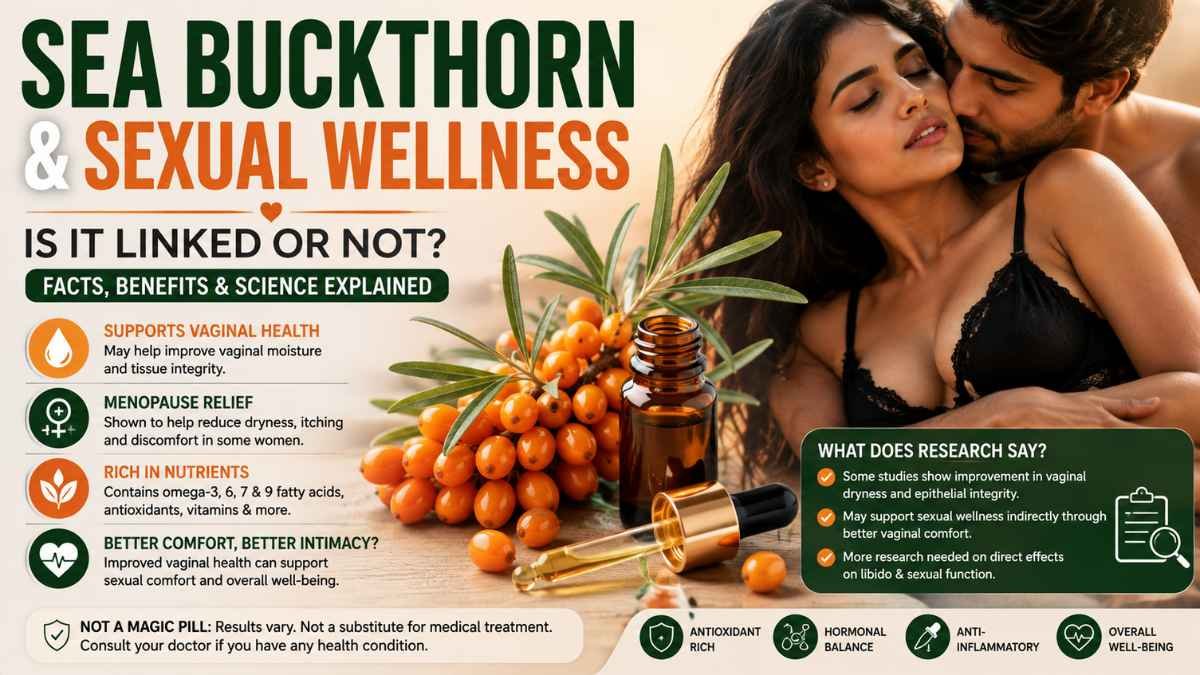
Sea buckthorn and sexual wellness may sound like an unusual combination, but the connection is beginning to attract attention because of research looking at sea buckthorn oil and vaginal health, particularly in women experiencing dryness and menopausal changes.
Sea buckthorn, scientifically known as Hippophae rhamnoides, is a plant whose berries and seeds contain various fatty acids, vitamins and other bioactive compounds. Sea buckthorn oil is commonly used in nutritional supplements and wellness products.
But does taking sea buckthorn oil actually improve sexual health?
The answer is more complicated than many supplement claims suggest.
There is some clinical evidence that sea buckthorn oil may help certain aspects of vaginal health, especially dryness and tissue integrity. However, that is not the same thing as proving that sea buckthorn directly increases libido, improves orgasm or acts as a sexual-performance supplement.
What is the connection between sea buckthorn and sexual wellness?
The most interesting connection is vaginal comfort.
For some women, particularly after menopause, declining estrogen levels can contribute to vaginal dryness, burning, itching and thinning of vaginal tissues. These symptoms can make sexual activity uncomfortable or painful.
And when sex becomes uncomfortable, sexual wellbeing can naturally be affected.
This is where sea buckthorn oil has been studied.
Researchers have investigated whether the fatty acids and other compounds in sea buckthorn oil could support the integrity and moisture of vaginal tissues.
The evidence is still limited, but some clinical studies have reported encouraging findings.
Sea buckthorn and vaginal dryness: What does the research say?
One of the most important studies was a randomized, double-blind, placebo-controlled trial involving 116 postmenopausal women who were experiencing symptoms such as vaginal dryness, itching or burning.
Participants received either sea buckthorn oil or a placebo for three months.
The sea buckthorn group consumed 3 grams of sea buckthorn oil per day.
Researchers found a significantly better improvement in the integrity of the vaginal epithelium in the sea buckthorn group compared with placebo. There was also a favorable trend in the overall vaginal health index.
That finding is important because it provides human clinical evidence—not simply a laboratory theory—that sea buckthorn oil may have a role in supporting vaginal tissue health.
But there is an important limitation.
The study was conducted in postmenopausal women with vaginal atrophy symptoms.
It does not prove that every woman will experience better sexual function by taking sea buckthorn oil.
Can sea buckthorn improve sexual function?
This is where we need to separate vaginal health from sexual function.
Vaginal dryness can make penetration uncomfortable.
Discomfort can affect sexual confidence, arousal and intimacy.
So improving vaginal comfort could potentially have an indirect effect on sexual wellbeing.
But that does not mean sea buckthorn has been proven to directly increase:
- Sexual desire
- Libido
- Arousal
- Orgasm
- Testosterone
- Sexual stamina
- Sexual performance
The available evidence is much stronger for vaginal health and dryness than for direct enhancement of sexual function. A systematic review of natural products for female sexual dysfunction also noted that evidence for many natural products remains limited.
So claims such as “sea buckthorn is a natural libido booster” should be treated cautiously.
Why vaginal dryness matters for sexual wellness
This connection is easier to understand.
Imagine someone who experiences vaginal dryness during sex.
Dryness can increase friction.
More friction can cause:
Discomfort → burning → pain → avoiding sex
Over time, that can affect intimacy and overall sexual wellbeing.
Therefore, anything that helps improve vaginal moisture or tissue health could potentially make sexual activity more comfortable for some women.
This is the reason researchers are interested in sea buckthorn oil for vaginal dryness.
But again, supporting vaginal comfort is different from directly stimulating sexual desire.
What is special about sea buckthorn oil?
Sea buckthorn oil contains several fatty acids, including omega-3, omega-6, omega-7 and omega-9 fatty acids, along with other bioactive compounds.
One component that receives particular attention is palmitoleic acid, often referred to as omega-7.
Researchers have investigated sea buckthorn oil because of its fatty-acid composition and potential effects on mucosal and skin health.
However, having a nutrient or fatty acid in a supplement does not automatically prove that taking that supplement will improve a specific health condition.
Clinical evidence matters.
And at the moment, the clinical evidence for sea buckthorn and sexual wellness is still relatively small.
Another study looked at sea buckthorn and vaginal symptoms
A more recent randomized controlled trial published in 2024 evaluated sea buckthorn oil capsules in 40 healthy women over the age of 45, with 20 participants receiving the sea buckthorn supplement and 20 receiving placebo.
After 12 weeks, participants in the sea buckthorn group reported improvements in several vaginal and vulvar symptoms, including dryness, itching and redness.
However, the researchers reported that the improvements in vaginal problems did not reach statistical significance between the sea-buckthorn and placebo groups at 12 weeks.
That detail matters.
It means the study is interesting, but it does not provide strong enough evidence to say:
“Sea buckthorn definitely treats vaginal problems.”
More research is needed.
Does sea buckthorn increase libido?
There is currently not enough good evidence to make that claim.
Libido is influenced by many factors, including:
- Hormones
- Stress
- Sleep
- Relationship quality
- Mental health
- Medications
- Physical health
- Pain during sex
- Menopause
- Sexual experiences
A supplement that may support vaginal tissue does not automatically change all of these factors.
So if someone takes sea buckthorn oil and experiences better sexual wellbeing, one possible explanation could be improved comfort rather than a direct increase in sexual desire.
That distinction is important.
What about sea buckthorn and menopause?
This is one of the more relevant areas of research.
Menopause can bring hormonal changes that affect vaginal tissues.
Some women experience:
- Vaginal dryness
- Burning
- Itching
- Pain during sex
- Reduced comfort during intimacy
The 2014 sea buckthorn trial specifically studied postmenopausal women with vaginal atrophy symptoms and found evidence of improved vaginal epithelial integrity after three months of supplementation.
This makes sea buckthorn oil and menopause-related vaginal dryness one of the more scientifically interesting areas for further research.
But it should not be presented as a replacement for established medical treatments.
Could better vaginal health indirectly improve sex?
Potentially, yes.
Think of sexual wellness as more than libido.
If sex is painful because of dryness, simply wanting sex more may not solve the problem.
Comfort matters.
If vaginal dryness improves, sexual activity may become more comfortable for some women.
That could potentially improve intimacy and sexual satisfaction indirectly.
This is why the relationship between sea buckthorn and sexual wellness may be more about comfort and vaginal health than about a direct aphrodisiac effect.
Is sea buckthorn an aphrodisiac?
There is currently insufficient clinical evidence to call sea buckthorn a proven aphrodisiac.
An aphrodisiac is generally understood as something that increases sexual desire or arousal.
The human studies available on sea buckthorn have primarily focused on areas such as vaginal health, dryness, mucosal integrity and other wellness outcomes—not on proving a direct libido-enhancing effect.
So if a product claims:
“Sea buckthorn dramatically boosts libido”
that claim goes beyond what the current clinical evidence can confidently establish.
Can sea buckthorn help with painful sex?
There is a possible indirect connection.
If vaginal dryness contributes to painful intercourse, and if sea buckthorn oil improves vaginal tissue health or moisture in some women, it could potentially contribute to greater comfort.
The 2014 trial found improvement in vaginal epithelial integrity among postmenopausal women taking sea buckthorn oil.
However, painful sex can have many causes.
It may be related to:
- Vaginal dryness
- Menopause
- Infections
- Pelvic floor problems
- Endometriosis
- Vulvar conditions
- Hormonal changes
- Psychological factors
- Other gynecological conditions
Therefore, persistent pain during sex should not simply be treated with a supplement.
What about sea buckthorn oil capsules?
Sea buckthorn is available in different forms, including oils and capsules.
But the form, dose and composition can vary substantially between products.
The 2014 clinical trial used 3 grams of sea buckthorn oil daily for three months, while another study used a specific sea buckthorn oil softgel product for 12 weeks.
That does not mean everyone should take exactly the same dose.
A research dose should not automatically be interpreted as a universal recommendation.
Supplement quality and formulation can also vary.
Is sea buckthorn safe?
The available clinical studies suggest that sea buckthorn oil can be tolerated by many people, but that does not mean every supplement is appropriate for everyone.
People who are pregnant, breastfeeding, taking medications or managing chronic health conditions should discuss supplements with a healthcare professional before starting them.
And anyone experiencing persistent vaginal symptoms should not use sea buckthorn as a substitute for diagnosis.
For example, unusual discharge, strong odour, bleeding, persistent burning or pain may indicate an underlying condition that requires proper evaluation.
Myth: Sea buckthorn directly increases sexual desire
Not proven.
This is probably the most important myth to address.
The research does not currently establish sea buckthorn as a direct libido-enhancing supplement.
The stronger evidence is around vaginal tissue health and dryness, particularly among postmenopausal women.
That distinction makes the story much more interesting because it shows how a supplement can potentially support one part of sexual wellness without being a direct sexual stimulant.
Myth: If vaginal dryness improves, libido automatically increases
Also not necessarily.
Sexual desire is complicated.
Someone may experience vaginal dryness and low libido at the same time, but solving dryness does not guarantee that sexual desire will increase.
Stress, anxiety, relationship factors, hormones, medications and mental wellbeing can all influence libido.
Therefore, improving physical comfort is only one potential part of improving sexual wellness.
Myth: Natural means it will work for everyone
Definitely not.
Natural products can contain biologically active compounds.
But people respond differently to supplements.
A clinical study may show an average effect in a particular group without meaning that every individual will experience the same result.
This is why evidence-based expectations are important.
Sea buckthorn may be promising.
That is different from saying it is proven to solve sexual problems.
Who may be most interested in sea buckthorn for sexual wellness?
Based on the available research, the most relevant group is women experiencing vaginal dryness or menopausal vaginal changes.
The 2014 study specifically involved postmenopausal women with vaginal dryness, itching or burning.
That does not mean younger women cannot use sea buckthorn products.
It simply means the strongest direct clinical evidence currently comes from a relatively specific population.
More studies involving different age groups and people with different sexual-health concerns would be useful.
What should you look for in a sea buckthorn supplement?
If someone is considering a sea buckthorn supplement, don't focus only on marketing phrases such as:
“Women’s wellness.”
“Sexual health.”
“Natural libido support.”
Instead, look at:
- The actual sea buckthorn oil content
- The amount per serving
- Other ingredients
- Manufacturer information
- Quality testing
- Suggested use
- Potential interactions
- Whether the product makes unsupported medical claims
And remember that supplements are not a substitute for medical treatment when a genuine health condition is present.
When should you see a doctor instead of taking a supplement?
If sexual discomfort is persistent, a supplement should not be the first and only answer.
Medical evaluation is particularly important if you have:
- Persistent vaginal dryness
- Pain during sex
- Burning or itching
- Unusual vaginal discharge
- Strong or unpleasant odour
- Bleeding after sex
- Pelvic pain
- Sudden changes in sexual function
These symptoms can have multiple causes.
Finding the actual cause is more important than simply taking a supplement marketed for sexual wellness.
So, is sea buckthorn linked to sexual wellness?
Yes—but indirectly, and the evidence is still developing.
The strongest connection is between sea buckthorn oil and vaginal health, especially vaginal dryness and tissue integrity in postmenopausal women.
A randomized controlled study found improved vaginal epithelial integrity after three months of sea buckthorn oil supplementation, while a newer small trial reported improvements in some self-reported vaginal symptoms but did not find statistically significant between-group differences for vaginal problems.
That means the evidence is promising but not definitive.
And there is currently not enough evidence to call sea buckthorn a proven treatment for low libido, sexual dysfunction or poor sexual performance.
The Bottom Line
The connection between sea buckthorn and sexual wellness is real enough to be scientifically interesting—but it needs to be described accurately.
Sea buckthorn oil has been studied for vaginal dryness, vaginal tissue integrity and menopausal vaginal symptoms, and some research has produced encouraging results.
However, that does not mean sea buckthorn is a proven libido booster or sexual-performance enhancer.
The potential connection is more indirect:
Sea buckthorn oil → possible support for vaginal tissue health → potentially greater vaginal comfort → potentially more comfortable intimacy.
But more high-quality research is needed before stronger claims can be made.
So if you see sea buckthorn marketed as a “natural sexual wellness” ingredient, don't immediately believe that it will increase desire or performance.
Look at what the science actually studied.
For now, sea buckthorn appears more promising for certain aspects of vaginal health than as a direct sexual-performance supplement.