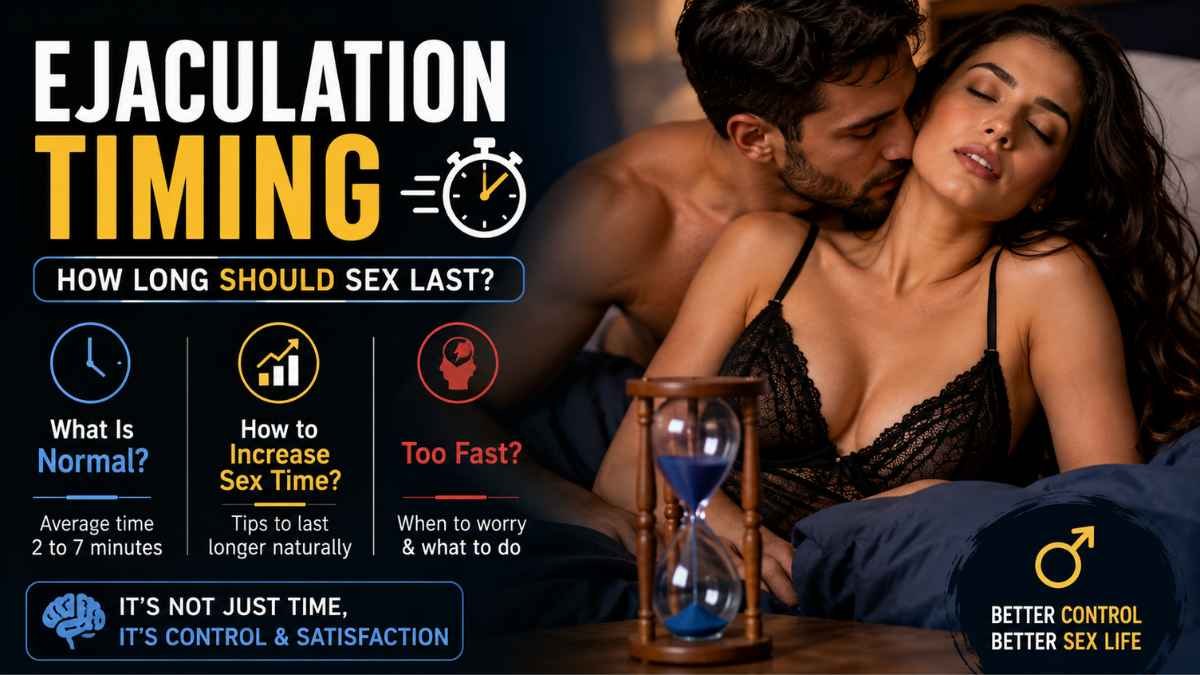
Ejaculation timing is one of the most searched—and misunderstood—parts of male sexual health. Questions like “How long should sex last?”, “What is normal sex timing?”, “How to increase sex time?” and “Why do I ejaculate too quickly?” are extremely common.
But there is one important fact many men don't know:
There is no universal number of minutes that makes sex “good” or “bad.”
Some couples may be satisfied with a shorter sexual encounter, while others may prefer longer intimacy. What matters medically is not simply the stopwatch. It is whether ejaculation happens sooner than desired, whether the person can control it, and whether it causes distress or problems in the sexual relationship.
How long should sex last?
There is no medically prescribed ideal duration for sex.
Research and sexual-health guidance show considerable variation in sex timing. Mayo Clinic notes that the average time from the beginning of intercourse to ejaculation is about five minutes, while NHS sexual-health guidance notes that studies have found a typical range of roughly 2–7 minutes.
That means a man should not automatically assume that something is wrong because he does not last 15, 20 or 30 minutes.
The internet often creates unrealistic expectations about sexual performance.
Real sexual experiences are much more variable.
What is considered normal ejaculation timing?
Normal ejaculation timing varies from person to person and even from one sexual encounter to another.
You may ejaculate sooner when:
- You are highly aroused
- You have not had sex for some time
- You are stressed
- You are tired
- You are anxious about performance
- You are with a new partner
- The situation is particularly exciting
NHS sexual-health guidance specifically notes that stress, tiredness and high arousal can influence how quickly ejaculation happens.
So one episode of early ejaculation does not automatically mean premature ejaculation.
What is premature ejaculation?
This is where the distinction becomes important.
According to the International Society for Sexual Medicine, lifelong premature ejaculation generally involves ejaculation before or within about one minute of vaginal penetration, occurring consistently or nearly consistently, along with an inability to delay ejaculation and negative personal consequences such as distress or frustration.
For acquired premature ejaculation, a clinically significant reduction in ejaculation time—often to around three minutes or less—can be part of the definition, again together with reduced control and personal distress.
So:
1 minute once ≠ automatically premature ejaculation.
Consistently ejaculating earlier than desired + inability to control it + distress = a possible sexual-health problem.
That distinction is extremely important.
Does a short sex time mean you have a problem?
Not necessarily.
A man may sometimes ejaculate quickly and have no ongoing problem.
Mayo Clinic says occasional premature ejaculation is common and isn't necessarily a cause for concern.
The problem becomes more relevant when it happens most or nearly all of the time, cannot be controlled and causes frustration, embarrassment, relationship problems or avoidance of intimacy.
Therefore, don't judge your sexual health based on one night.
Look at the overall pattern.
Why do some men ejaculate too quickly?
There isn't always one single cause.
Premature ejaculation can involve psychological, relationship and physical factors.
Possible contributors include:
- Performance anxiety
- Stress
- Depression
- Relationship difficulties
- High sexual arousal
- Erectile difficulties
- Hormonal factors
- Prostate problems
- Thyroid problems
- Certain neurological factors
The NHS notes that both psychological and physical factors can contribute to ejaculation problems.
This is why simply telling someone to “control yourself” is not a useful medical explanation.
Can stress affect sex timing?
Absolutely.
Stress and sexual performance are closely connected.
If a man is constantly thinking:
“Will I last long enough?”
that thought itself can increase anxiety and make it harder to remain relaxed.
Performance anxiety can therefore become part of a cycle:
Worry → increased arousal/anxiety → faster ejaculation → disappointment → more worry next time.
NHS sexual-health guidance lists stress, anxiety, tiredness and worries about sexual performance among factors associated with ejaculating sooner than desired.
So improving sex timing is not always about physical techniques alone.
Mental relaxation can matter too.
Is there a fixed “best sex timing”?
No.
This is one of the biggest myths.
There is no rule saying:
5 minutes = normal
10 minutes = better
20 minutes = excellent
Sexual satisfaction isn't determined by a stopwatch.
Some people may prefer shorter intercourse with more overall intimacy, while others may prefer longer intercourse.
The important question is:
Are both partners comfortable and satisfied?
That is much more meaningful than comparing yourself with numbers found online.
How to increase sex time naturally
If a man regularly ejaculates sooner than he wants and wants to increase sex time, there are several evidence-based approaches that healthcare professionals may recommend.
1. Reduce performance pressure
Constantly monitoring the clock can make sexual performance anxiety worse.
Instead of thinking:
“I have to last 20 minutes.”
focus on staying relaxed and communicating with your partner.
The goal is not to beat a timer.
The goal is better sexual control and satisfaction.
2. Try the stop-start technique
The stop-start technique is one behavioral approach used for premature ejaculation.
The idea is to stop sexual stimulation when ejaculation feels close, allow the urge to decrease, and then resume.
With practice, some men may become better at recognizing and managing the point just before ejaculation. Mayo Clinic lists stop-start techniques among behavioral treatments for premature ejaculation.
3. Pelvic floor exercises
Pelvic floor muscles are involved in sexual function.
Mayo Clinic notes that pelvic floor exercises, commonly called Kegel exercises, can help strengthen these muscles and may help some men improve ejaculation control.
Consistency matters more than doing them occasionally.
4. Use condoms if appropriate
For some men, condoms can reduce penile sensitivity and may help delay ejaculation.
Mayo Clinic includes condoms among behavioral approaches that may help with premature ejaculation.
This doesn't mean condoms are a guaranteed solution.
Different people respond differently.
5. Address anxiety and stress
If anxiety is contributing to premature ejaculation, counseling or sex therapy may help.
Mayo Clinic notes that counseling can help reduce performance anxiety and improve coping with stress, particularly when combined with other treatments when appropriate.
Can masturbation help increase sex time?
This question comes up frequently.
Mayo Clinic notes that, in some cases, a healthcare provider may suggest masturbating an hour or two before intercourse as one behavioral approach for premature ejaculation.
However, this is not a universal solution.
It may work for some men and not for others.
And if ejaculation timing is consistently causing distress, it is better to understand the underlying issue rather than relying on one trick every time.
Does frequent sex make you last longer?
Not necessarily.
Some men may notice better control when they become more comfortable with sexual arousal, while others may still experience premature ejaculation regardless of how frequently they have sex.
Sexual experience can influence confidence, but it doesn't guarantee better ejaculation control.
If the problem persists across sexual encounters, professional assessment can be useful.
Does age affect ejaculation timing?
It can.
Sexual function changes throughout life, and acquired premature ejaculation can develop after a period when ejaculation timing was previously satisfactory.
The ISSM distinguishes between lifelong and acquired premature ejaculation, with acquired PE developing after previous sexual experiences without the problem.
A sudden change in ejaculation timing is therefore worth paying attention to, particularly if it continues.
What if you suddenly start ejaculating much faster?
A sudden change shouldn't automatically be dismissed.
New ejaculation problems can sometimes be associated with:
- Stress or anxiety
- Relationship changes
- Erectile dysfunction
- Prostate problems
- Thyroid problems
- Other health conditions
- Medication changes
The NHS specifically lists prostate and thyroid problems among possible physical contributors to ejaculation problems.
If the change is persistent, discussing it with a healthcare professional can help identify the cause.
Can erectile dysfunction affect sex timing?
Yes.
Erection problems and premature ejaculation can sometimes occur together.
A man who worries that he might lose his erection may become highly focused on ejaculation and rush sexual activity.
Conversely, some treatments for erectile dysfunction may also influence sexual function.
If both erection problems and ejaculation problems are present, it is better to discuss both with a healthcare professional rather than treating only one symptom. Mayo Clinic notes that clinicians may evaluate hormone levels and other factors when erection problems accompany early ejaculation.
Does “lasting longer” always mean better sex?
No.
This is perhaps the most important myth to break.
Longer intercourse does not automatically mean greater sexual satisfaction.
Sexual satisfaction can depend on:
- Communication
- Emotional connection
- Arousal
- Comfort
- Foreplay
- Lubrication
- Sexual preferences
- Feeling relaxed
- Mutual satisfaction
A couple can have a satisfying sexual experience without intercourse lasting a very long time.
So the goal shouldn't simply be:
“How can I last as long as possible?”
A better goal is:
“How can I have better control and a satisfying sexual experience for both partners?”
What about sex time increase supplements?
The market is full of products claiming to increase sex time, improve stamina or delay ejaculation.
Be careful with these claims.
A supplement being marketed as “natural” doesn't automatically mean it has been clinically proven to treat premature ejaculation.
Some products may contain multiple ingredients without strong evidence for their claimed sexual benefits.
If ejaculation timing is a persistent problem, evidence-based treatments are a better starting point than blindly trying supplements.
Are medicines available for premature ejaculation?
Yes.
Premature ejaculation is a treatable sexual-health condition.
Depending on the situation, doctors may consider behavioral techniques, counseling, topical numbing agents or prescription medicines. Mayo Clinic lists several treatment approaches and notes that treatment may involve a combination of methods.
Topical numbing products can reduce sensation and delay ejaculation, but they can also reduce sexual sensation or pleasure for one or both partners.
Prescription medicines should be used only under appropriate medical guidance.
When should you see a doctor?
Consider talking with a healthcare professional if:
- You ejaculate sooner than you want during most sexual encounters
- You cannot delay ejaculation
- The problem is causing significant distress
- You are avoiding intimacy because of it
- The problem suddenly developed after previously normal sexual function
- You also have erection problems
- You have other urinary, prostate or hormonal symptoms
Premature ejaculation is common and treatable, so there is no medical reason to suffer silently.
The Bottom Line
When it comes to sex timing, there is no magic number that every man needs to reach.
Research suggests that ejaculation during intercourse commonly occurs within a few minutes, with one source citing an average of around five minutes and NHS sexual-health guidance describing a research range of roughly 2–7 minutes.
Occasionally ejaculating quickly is normal.
But if you consistently ejaculate sooner than you want, cannot control it and feel distressed because of it, you may be dealing with premature ejaculation—a common and treatable sexual-health condition.
And if your goal is to increase sex time, don't focus only on the clock.
Reducing performance anxiety, improving pelvic-floor control, using behavioral techniques such as stop-start, and seeking professional help when necessary can be more useful than chasing unrealistic numbers.
The real measure of good sex isn't how many minutes you lasted.
It's whether you had control, comfort, communication and satisfaction for both partners.