How much fluid is released during female ejaculation? This is a question many people search online, especially when they hear about female ejaculation, squirting, or fluid release during orgasm.
But there is a lot of confusion around the subject.
Some women may release a small amount of fluid during sexual stimulation or orgasm. Others may experience squirting, which can involve a much larger amount of fluid. And many women may never experience either.
All of these experiences can fall within normal sexual variation.
So, is there a specific female ejaculation volume that every woman should have?
No.
There is no single number that defines normal female ejaculation.
How much fluid is released during female ejaculation?
The amount depends on what is actually being described.
Recent research distinguishes female ejaculation from vaginal squirting.
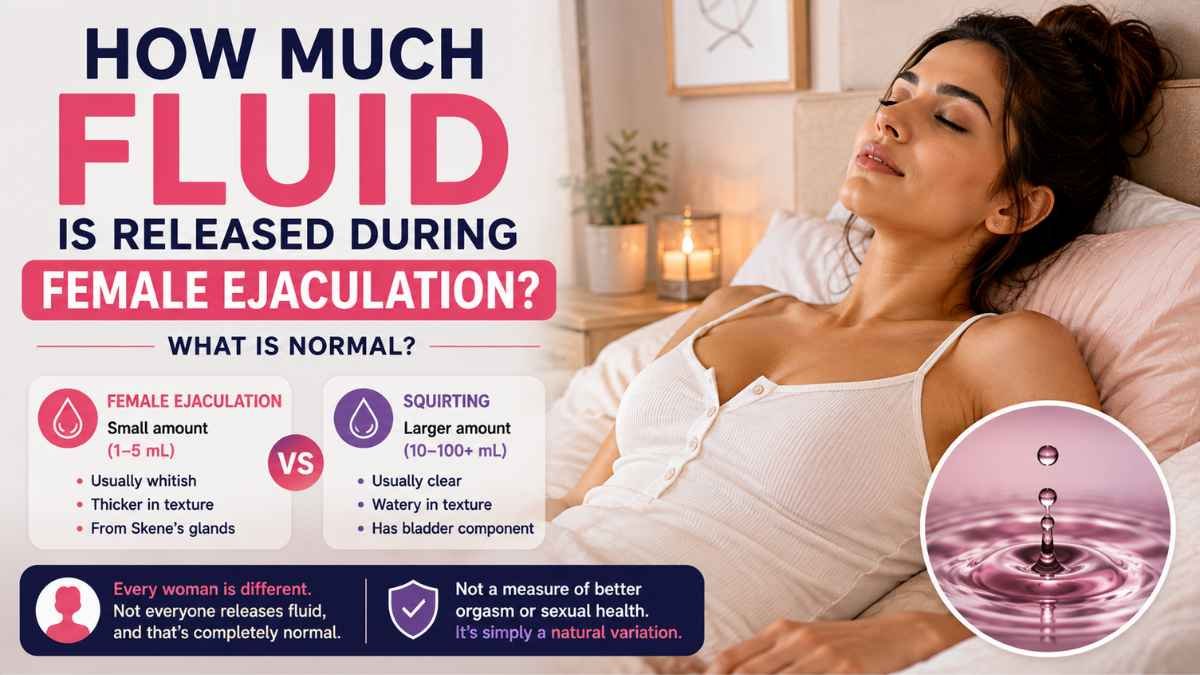
A 2026 systematic review found female ejaculation to generally be a small-volume release of around 1–5 mL, typically described as a whitish or viscous fluid associated with the paraurethral, or Skene's, glands.
That's a relatively small amount.
It may be only a few drops or a small quantity that a woman barely notices.
So if someone asks:
“How much do women ejaculate?”
the answer is usually much less than what is commonly portrayed online when talking specifically about female ejaculation.
Female ejaculation is not the same as squirting
This is probably the most important thing to understand.
The terms are often used interchangeably online, but researchers increasingly distinguish between them.
Female ejaculation
Generally:
- Small volume
- Often whitish or cloudy
- More viscous
- Associated with the Skene's/paraurethral glands
- Contains prostate-specific antigen (PSA)
Squirting
Generally:
- Larger volume
- Usually clear and watery
- Expelled through the urethra
- Has a significant bladder-derived component
- Can contain urea and creatinine
A 2026 systematic review reported female ejaculation around 1–5 mL, while squirting had a much larger median volume of about 60 mL, with a very wide reported range.
That is why asking simply “how much female ejaculation fluid comes out?” can be misleading unless we first clarify which phenomenon we're talking about.
How much fluid comes out when a woman squirts?
Squirting can involve substantially more fluid than female ejaculation.
The International Society for Sexual Medicine notes that the amount can vary widely, from a small amount to more than 100 mL.
The 2026 systematic review reported a median squirting volume of approximately 60 mL, with studies reporting a very wide range of 15–900 mL.
This enormous variation is one reason there is no single answer to:
“What is the normal squirting volume?”
A woman may experience only a small amount, while another may release considerably more.
Neither number alone determines whether something is medically wrong.
Why is squirting fluid different from female ejaculate?
The difference appears to involve where the fluid comes from.
Female ejaculation is associated with the Skene's glands, which are located around the urethra.
Researchers have detected PSA, or prostate-specific antigen, in female ejaculate. Women don't have a male prostate, but the Skene's glands can produce PSA.
Squirting, on the other hand, appears to have a major bladder component.
Research using biochemical analysis and ultrasound has found evidence of bladder filling during sexual stimulation followed by bladder emptying during squirting.
So the two phenomena appear to have different physiological origins.
Is squirting just urine?
This question has generated a lot of confusion.
The most accurate answer is:
Squirting has a significant bladder-derived component, but simply calling it “just urine” is an oversimplification.
Studies have found urea and creatinine in squirting fluid, consistent with a bladder origin. At the same time, researchers have also detected substances associated with the Skene's glands.
So it isn't scientifically accurate to treat every case of squirting as ordinary urinary incontinence.
Recent research specifically emphasizes distinguishing female ejaculation, squirting and coital incontinence because they are not the same physiological phenomenon.
Can female ejaculation happen during orgasm?
Yes.
Female ejaculation can occur around orgasm, but it doesn't necessarily happen at exactly the same moment.
This is another common misconception.
A 2026 systematic review found that only about 20% of women in the reviewed data reported that ejaculation or squirting always coincided with orgasm.
That means fluid release can occur:
- During sexual arousal
- Before orgasm
- Around orgasm
- During orgasm
- Sometimes after orgasm
There is therefore no fixed female ejaculation timing.
How long does it take for a woman to ejaculate?
There is no scientifically established average such as:
5 minutes
or
10 minutes
or
20 minutes.
Female ejaculation timing varies between individuals and even between sexual experiences for the same person.
Some women may experience fluid release during intense arousal, while others may experience it around orgasm.
Some may never experience it.
Therefore, there is no medically required female ejaculation time that a woman should try to reach.
Does every woman ejaculate?
No.
This is extremely important.
Some women experience female ejaculation.
Some experience squirting.
Some experience both.
And many women experience neither.
The International Society for Sexual Medicine notes that estimates of how many women experience ejaculation vary considerably between studies, partly because researchers have used different definitions and methods.
A 2026 systematic review found prevalence estimates ranging from approximately 10% to 54% across several studies.
So there is no reason to assume that every woman should experience fluid release.
Does not ejaculating mean something is wrong?
No.
A woman does not need to experience female ejaculation to have:
- An orgasm
- Sexual pleasure
- Sexual satisfaction
- A healthy sex life
Female ejaculation is a variation of sexual response, not a requirement for sexual health.
Some women may orgasm regularly without ever noticing any fluid release.
That is completely normal.
Does more fluid mean a stronger orgasm?
No.
This is another myth that can create unnecessary pressure.
The amount of fluid released does not provide a reliable measurement of orgasm intensity.
A woman can experience a very pleasurable orgasm without releasing any visible fluid.
Another woman may release a significant amount of fluid without that necessarily meaning her orgasm was stronger.
Sexual pleasure is much more complicated than fluid volume.
Can a woman release fluid without having an orgasm?
Yes.
Fluid release doesn't necessarily mean orgasm occurred at that exact moment.
Research has found that female ejaculation and squirting can occur during different stages of sexual arousal, and not every episode coincides with orgasm.
So:
Fluid release does not automatically equal orgasm.
And:
Orgasm does not require fluid release.
What causes female ejaculation?
Female ejaculation is believed to involve the Skene's glands, also called the paraurethral glands.
These glands are located near the urethra and are sometimes described as the female equivalent of the prostate because they can produce PSA.
During sexual stimulation, these glands may contribute fluid that is expelled through the urethra.
The exact physiology is still being researched, but current evidence supports female ejaculation as a genuine physiological sexual response rather than a medical abnormality.
What causes squirting?
Squirting appears to involve the urinary bladder.
Studies using ultrasound have observed the bladder filling during sexual stimulation and then emptying during squirting. Biochemical testing has also found substances associated with urine.
This helps explain why squirting can involve a considerably larger fluid volume than female ejaculation.
It also explains why some women describe a sensation similar to needing to urinate shortly before squirting.
Is a large amount of fluid normal?
It can be.
A larger fluid release does not automatically indicate a health problem.
Squirting volume can vary dramatically, and research has documented everything from relatively small amounts to much larger releases.
So there is no simple rule such as:
“10 mL is normal but 50 mL is abnormal.”
That isn't how female sexual physiology works.
Is a very small amount normal?
Yes.
Female ejaculation can involve only a few millilitres.
Some women may notice only a small amount of whitish or clear fluid.
Others may not notice the release at all.
The 2026 systematic review's description of female ejaculation as approximately 1–5 mL helps put the typical scale into perspective, although individual experiences can vary.
Does female ejaculation happen after sex?
It can happen during sexual activity, around orgasm or shortly afterward.
If a woman notices a small amount of fluid after intercourse, however, that doesn't automatically mean it was female ejaculation.
The fluid could also be:
- Vaginal lubrication
- Cervical fluid
- Semen from a male partner
- Squirting fluid
- Female ejaculate
The timing and appearance alone cannot always identify the source.
Can semen from a male partner be mistaken for female ejaculation?
Yes.
After vaginal intercourse, fluid leaking from the vagina may contain semen from the male partner.
This is one reason it isn't possible to identify every wet spot after sex as female ejaculation.
Female ejaculate is generally associated with the urethra, while semen is deposited in the vagina during ejaculation.
The two can also mix.
So if someone is trying to understand their own sexual response, simply looking at fluid after sex isn't always enough to determine exactly where it came from.
Can lubrication be mistaken for ejaculation?
Yes.
This is another common source of confusion.
During sexual arousal, the vagina naturally becomes lubricated.
The amount of lubrication can vary significantly.
This fluid is different from female ejaculation and squirting, although all three can occur during the same sexual experience.
The 2026 ISSM research summary groups vaginal lubrication, female ejaculation and squirting as different forms of peri-orgasmic fluid and emphasizes that they have different biochemical characteristics.
Does squirting mean a woman has a bladder problem?
Not necessarily.
Normal squirting and coital incontinence are different phenomena.
Coital incontinence refers to involuntary urine leakage associated with sexual activity and can be related to conditions such as stress urinary incontinence or detrusor overactivity.
A 2026 systematic review found that women with physiological ejaculation or squirting did not show the same urodynamic abnormalities seen in women with coital incontinence.
So experiencing squirting alone does not mean that a woman has urinary incontinence.
What if fluid release happens every time?
That can still be normal.
Some women may experience squirting frequently, while others experience it only occasionally.
There is no medically required frequency.
Sexual responses can change depending on:
- Type of stimulation
- Arousal
- Individual anatomy
- Pelvic floor activity
- Hormonal factors
- Psychological factors
- Sexual context
A 2026 study also suggests that psychosexual factors may influence the experience and perception of squirting, although researchers emphasize that larger studies are needed.
What if a woman never releases fluid?
That is also normal.
There is no health requirement to experience female ejaculation or squirting.
A woman who never ejaculates can still have normal sexual function and satisfying orgasms.
In fact, focusing too much on whether fluid is released can create unnecessary performance pressure.
Sexual health isn't measured by how much fluid comes out.
Can pornography create unrealistic expectations?
Absolutely.
Pornographic content can make squirting appear much more common and dramatically larger-volume than it is in ordinary sexual experiences.
Recent research has specifically highlighted exaggerated pornography depictions as a source of unrealistic expectations and sexual performance pressure.
This can lead people to wonder:
“Why doesn't this happen to my partner?”
or:
“Why don't I release that much fluid?”
There is no reason to compare real bodies with what is shown on a screen.
When should unusual fluid be checked by a doctor?
Female ejaculation and squirting themselves generally do not require treatment.
But unusual vaginal or urinary symptoms should not automatically be attributed to sexual fluid release.
Medical advice is appropriate if fluid release is accompanied by:
- Blood
- Significant pain
- Burning
- Strong or foul odour
- Unusual vaginal discharge
- Persistent urinary leakage
- Pelvic pain
- New urinary symptoms
These symptoms can have other causes and may need evaluation.
The biggest myths about female ejaculation
Myth 1: Every woman ejaculates
False.
Some women do; many don't.
Myth 2: There is a fixed female ejaculation volume
False.
There is considerable variation.
Myth 3: Female ejaculation and squirting are exactly the same
False.
Current research distinguishes them based on volume, composition and anatomical origin.
Myth 4: More fluid means a stronger orgasm
Not proven.
Fluid volume isn't a reliable measurement of pleasure or orgasm intensity.
Myth 5: Squirting is simply urinary incontinence
Not necessarily.
Normal squirting and coital incontinence are physiologically different phenomena.
Myth 6: A woman who doesn't ejaculate has a sexual problem
False.
Female ejaculation isn't required for orgasm or sexual satisfaction.
So, how much fluid is actually released?
If we're talking specifically about female ejaculation, recent evidence suggests it is generally a small-volume release, around 1–5 mL.
If we're talking about squirting, the amount can be dramatically larger. One recent review reported a median volume around 60 mL, with studies showing a very wide range.
And some women experience neither.
That is why there isn't one number that can be called the normal female ejaculation volume.
The Bottom Line
So, how much fluid is released during female ejaculation?
For female ejaculation specifically, current evidence describes it as generally a small amount of fluid, roughly 1–5 mL. It is associated with the Skene's glands and can contain PSA.
Squirting is different. It generally involves a much larger volume of clear fluid and appears to have a substantial bladder-derived component. Research has reported a median squirting volume of around 60 mL, but the amount can vary enormously.
Most importantly, there is no required female ejaculation amount, no fixed female ejaculation timing and no rule that every woman should experience it.
Some women ejaculate.
Some squirt.
Some experience both.
And many experience neither.
None of these alone determines whether a woman is sexually healthy or whether she had a satisfying orgasm.