Is it safe to swallow semen? It is a common sexual-health question, but many people don't know the actual answer.
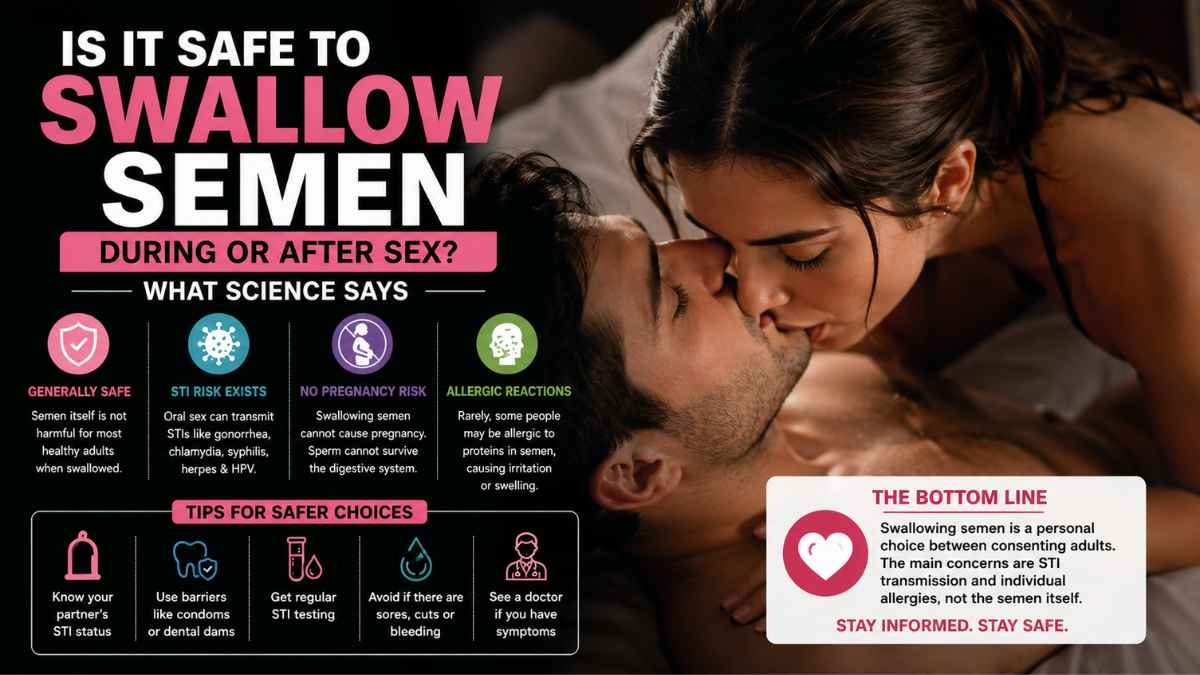
For most healthy adults, swallowing semen itself is not considered inherently harmful. The bigger health concern is whether the person producing the semen has a sexually transmitted infection (STI), because oral sex can transmit several infections.
So the question isn't simply whether semen is “safe” or “unsafe.”
It depends on sexual health, STI status, symptoms and individual sensitivity.
What exactly is semen?
Semen is the fluid released from the penis during ejaculation.
It contains sperm cells along with fluids produced by several reproductive glands, including the seminal vesicles and prostate.
It is therefore important to distinguish between sperm and semen.
Sperm are microscopic reproductive cells.
Semen is the fluid that carries those cells.
When someone asks whether it is safe to “swallow sperm,” they are generally referring to swallowing semen.
Is it safe to swallow semen?
For most people, there is no general medical rule saying semen must not be swallowed.
Semen is not a poison, and swallowing it does not normally cause harm simply because it is semen.
However, semen is also a bodily fluid, and the person producing it may carry an infection without knowing it.
That is where the real health consideration begins.
Can swallowing semen transmit STIs?
Yes.
Oral sex can transmit several sexually transmitted infections.
The CDC notes that infections including gonorrhea, chlamydia, syphilis and herpes can be transmitted through oral sex.
This means that even though swallowing semen itself isn't inherently dangerous, exposure to infected sexual fluids can create an infection risk.
And importantly, many STIs can exist without obvious symptoms.
Someone can look completely healthy and still have an STI.
What STIs can be transmitted through oral sex?
Depending on the infection and type of sexual contact, oral sex can transmit:
- Gonorrhea
- Chlamydia
- Syphilis
- Herpes
- HPV
- HIV, although the risk through oral sex is extremely low compared with vaginal or anal sex
The CDC specifically identifies several bacterial and viral STIs that can be transmitted through oral sex.
So if someone is considering swallowing semen after sex, knowing the partner's STI status is much more important than worrying about semen itself.
What about HIV from swallowing semen?
This is where the risk is often exaggerated online.
According to the CDC, HIV transmission through oral sex has extremely low to no risk compared with vaginal or anal sex.
However, the risk isn't described as absolutely impossible in every circumstance.
Factors that may increase the risk include:
- Open sores in the mouth
- Bleeding gums
- Genital sores
- Blood exposure
- Other STIs
- A partner with HIV who has a detectable viral load
The CDC notes that these factors can increase the already very low HIV risk associated with oral sex.
Does swallowing semen cause pregnancy?
No.
Swallowing semen cannot cause pregnancy.
When semen is swallowed, it enters the digestive system. Pregnancy requires sperm to reach the reproductive tract and fertilize an egg.
The digestive and reproductive systems are separate.
So:
Swallowing semen → cannot cause pregnancy.
Pregnancy risk becomes relevant when sperm enters or reaches the reproductive tract, not when semen is swallowed.
Does swallowing sperm have any health benefits?
There is no established medical evidence that swallowing semen provides special health benefits.
You may see online claims that semen contains proteins, minerals or other nutrients and therefore acts like a nutritional supplement.
That conclusion doesn't follow from the science.
The quantities involved are small, and there is no established reason to consume semen for nutritional purposes.
So claims such as:
“Swallowing semen is good for your skin.”
or
“Semen works like a natural health supplement.”
should not be presented as established medical facts.
Does semen contain nutrients?
Semen contains various substances, including proteins, enzymes, sugars and minerals.
But the presence of nutrients does not make semen a meaningful dietary source.
The body doesn't need semen as a nutritional supplement.
Therefore, if someone chooses to swallow semen as part of consensual sexual activity, it should be viewed as a sexual choice—not a health practice.
Can someone be allergic to semen?
Yes, although semen allergy is rare.
A semen allergy, also called seminal plasma hypersensitivity, is an immune reaction to proteins found in semen rather than usually to the sperm cells themselves.
It can affect areas that come into contact with semen, including the mouth.
Possible symptoms include:
- Burning
- Itching
- Redness
- Swelling
- Hives
- Swelling of the lips or tongue
- Difficulty breathing
In severe cases, a systemic allergic reaction can occur.
So if someone repeatedly develops unusual symptoms immediately after contact with semen, it shouldn't automatically be assumed to be an STI.
An allergy is another possible explanation.
What if the throat burns after swallowing semen?
A burning throat doesn't automatically mean that semen is harmful.
Possible causes include:
- An allergic reaction
- Irritation
- An existing sore throat
- An STI affecting the throat
- Another unrelated infection
If the symptom repeatedly appears after exposure to semen, medical evaluation can help determine the cause.
Especially important: swelling of the lips, tongue or throat or difficulty breathing requires urgent medical attention, because these can be signs of a severe allergic reaction.
Can oral sex cause a throat infection?
Yes.
Certain STIs can infect the throat following oral sexual exposure.
Gonorrhea, for example, can infect the throat, and other STIs can also be transmitted through oral sex.
This is why someone with a new sexual partner may need to consider STI testing if they develop persistent throat or mouth symptoms after oral sex.
A normal-looking throat does not necessarily prove that no infection is present.
Is swallowing semen safer than having unprotected vaginal sex?
When talking specifically about HIV, oral sex is substantially lower risk than vaginal or anal sex. The CDC describes oral sex as having extremely low to no HIV transmission risk, while vaginal and anal sex carry higher risks.
But that doesn't mean oral sex is completely risk-free for all STIs.
Gonorrhea, syphilis, herpes and other infections can still be transmitted through oral sexual contact.
So “lower HIV risk” should not be interpreted as “no STI risk.”
Does ejaculation in the mouth increase the risk?
For HIV, the CDC notes that the risk from oral sex is extremely low, but ejaculation in the mouth can increase exposure to semen compared with avoiding ejaculation in the mouth.
Other factors—such as mouth sores, bleeding gums and the presence of other STIs—can also influence risk.
If someone wants to reduce exposure to semen during oral sex, using a condom is one option.
Can brushing your teeth before oral sex increase risk?
It is worth being careful with oral hygiene immediately before sexual activity.
Aggressive brushing or flossing can irritate the gums and potentially create small areas of bleeding.
Because blood exposure can influence infection risk, particularly for HIV, the CDC has advised avoiding activities that cause bleeding in the mouth around oral-sex exposure.
That doesn't mean normal oral hygiene is bad.
It simply means avoid deliberately causing gum irritation or bleeding immediately before oral sex.
Can a condom make oral sex safer?
Yes.
Using a condom during oral sex can reduce direct exposure to semen and genital fluids and therefore reduce the risk of transmitting several STIs.
Some people use condoms specifically during oral sex when:
- STI status is unknown
- They have a new partner
- They want to avoid semen exposure
- One partner has an STI
- There are concerns about oral sores or cuts
It's a simple way to reduce exposure.
What if both partners are tested?
If both partners have appropriate STI testing, understand their results and are in a mutually agreed relationship, the risk profile is different from a situation where STI status is unknown.
However, testing isn't always a guarantee that every infection is ruled out immediately because different infections have different testing windows and testing requirements.
That's why communication and appropriate testing matter.
Can swallowing semen cause stomach problems?
For most people, swallowing semen doesn't cause digestive problems.
However, someone with a rare semen allergy may experience symptoms such as nausea or vomiting as part of a systemic allergic reaction.
If someone repeatedly develops symptoms after swallowing semen, particularly when those symptoms occur soon after exposure, they should discuss it with a healthcare professional.
Does semen have a strong taste or smell?
Semen can naturally vary in taste and smell.
Factors such as diet, hydration and individual body chemistry may contribute to differences.
A particular taste doesn't automatically indicate that something is medically wrong.
However, a new strong or unusual odour, especially when accompanied by genital symptoms, may warrant medical evaluation.
What if there is blood in semen?
Blood in semen is called hematospermia.
It can have several causes and isn't always a sign of something serious.
But if blood in semen is persistent, recurrent or accompanied by pain, urinary symptoms or other concerning symptoms, it should be medically evaluated.
If blood is present during oral sex, it can also change the infection-exposure situation because blood can carry certain infections.
Does swallowing semen affect fertility?
No.
Swallowing semen has no effect on a person's ability to become pregnant.
The digestive system breaks down swallowed substances.
It does not send sperm to the reproductive system.
Likewise, swallowing semen does not increase fertility.
Is it okay to swallow semen after sex?
For a healthy adult, yes, it can be a personal sexual choice, provided they understand the potential risks.
There is no medical requirement to swallow semen, and there is no established health benefit requiring anyone to do so.
The important considerations are:
Know your partner's STI status.
Avoid oral exposure when there are active sores or bleeding.
Consider barriers if STI status is unknown.
Pay attention to unusual symptoms.
What are the biggest myths?
Myth 1: Swallowing semen is poisonous
False.
Semen is not inherently poisonous.
Myth 2: Swallowing semen causes pregnancy
False.
Swallowed semen cannot cause pregnancy.
Myth 3: Oral sex cannot transmit STIs
False.
Several STIs can be transmitted through oral sex.
Myth 4: Swallowing semen has proven health benefits
Not established.
There is no strong medical evidence that swallowing semen provides meaningful health benefits.
Myth 5: HIV is easily transmitted through oral sex
False.
The CDC describes HIV transmission through oral sex as extremely low to no risk, although certain circumstances can increase risk.
Myth 6: Semen allergy doesn't exist
False.
Semen allergy is rare but medically recognized.
When should you see a doctor?
Medical evaluation is a good idea if you develop:
- Repeated burning after semen exposure
- Swelling of the lips or tongue
- Hives
- Persistent throat symptoms
- Difficulty swallowing
- Difficulty breathing
- Mouth or genital sores
- Unusual genital discharge
- Persistent pain
- Other symptoms after a possible STI exposure
Severe swelling or breathing difficulty after semen exposure can indicate a serious allergic reaction and requires urgent medical attention.
The Bottom Line
So, is it safe to swallow semen during or after sex?
For most healthy adults, swallowing semen itself is not inherently harmful.
The bigger concern is STI transmission.
Oral sex can transmit infections including gonorrhea, chlamydia, syphilis and herpes, while HIV transmission through oral sex is considered extremely low compared with vaginal or anal sex.
Swallowing semen cannot cause pregnancy, and there is no established medical evidence that consuming semen provides special health benefits.
A rare exception is semen allergy, which can cause symptoms ranging from localized burning and swelling to, rarely, a severe allergic reaction.
So the simplest answer is:
Semen itself isn't the main danger. The partner's sexual-health status is what matters most.
If both partners know their STI status and there are no concerning symptoms, swallowing semen is generally considered a low-risk personal sexual choice.
If STI status is unknown, there are sores or bleeding, or symptoms develop afterward, using barriers and seeking appropriate medical advice is the safer approach.