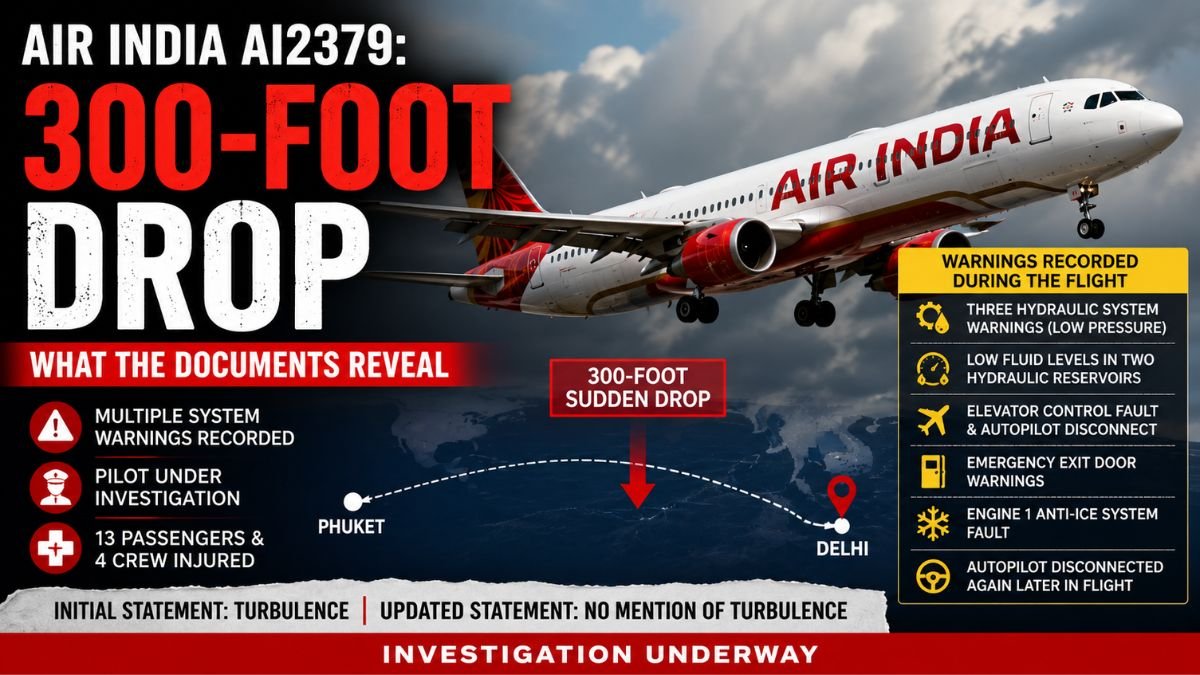
Air India flight AI2379 from Phuket to Delhi suffered a sudden 300-foot loss of altitude on August 4, injuring 13 passengers and four crew members. While the airline initially described the incident as a brief episode of in-flight turbulence, a maintenance report printed after the aircraft landed shows that the Airbus A320neo had recorded multiple technical warnings during the flight.
The maintenance report was printed at 11:14 am on August 4, shortly after the aircraft landed in Delhi. Around two hours later, Air India said the aircraft had experienced a "brief in-flight turbulence-related event" during cruise. Five hours after that statement, the airline issued an updated version that removed the reference to turbulence.
Maintenance Report Shows Multiple Hydraulic Warnings
The maintenance report indicates that the aircraft experienced warnings involving all three hydraulic systems at around 9:32 am.
At the same time, the report showed low fluid levels in two of the hydraulic reservoirs.
The Airbus A320neo normally operates with three separate hydraulic systems. The design provides redundancy, meaning that if one system encounters a problem, the other systems can continue powering important functions including flight controls, landing gear and brakes.
According to the report, however, warnings appeared for low pressure across all three systems.
Hydraulic systems are particularly important because they allow pilots to operate the aircraft's control surfaces. Multiple hydraulic warnings occurring together are therefore more significant than a failure involving only one system.
The report also recorded a problem involving the aircraft's elevator controls, which help control the aircraft's pitch.
At approximately the same time, the autopilot disconnected.
More Problems Appeared During the Flight
The technical warnings did not stop with the hydraulic systems.
At around 9:33 am, the aircraft generated a warning associated with the right front emergency exit door.
Another emergency exit door warning appeared around 9:35 am, this time involving the right rear door.
Later, at approximately 10:16 am, the aircraft's Engine 1 anti-ice system showed a fault connected to a valve pressure issue.
The autopilot then disconnected again at around 10:52 am.
The maintenance report therefore records a series of warnings involving different aircraft systems during the flight.
Importantly, the report's warnings do not necessarily mean that the corresponding systems had completely failed. Modern aircraft are designed with redundancy, and pilots are trained to deal with individual system problems.
However, the combination of hydraulic, flight-control and other warnings is significant enough to warrant investigation, according to the NDTV report.
Air India's Statements Changed Within Hours
The sequence of Air India's public statements has also drawn attention.
The airline's first statement, issued at 1:14 pm, said the aircraft had experienced a brief in-flight turbulence-related event during cruise, resulting in a momentary change in altitude.
It also said there had been no serious injuries and that a small number of passengers and crew members with minor injuries were taken for medical assessment.
At 6:55 pm, Air India issued an updated statement.
The new statement said flight AI2379 had experienced a sudden loss of altitude during cruise and landed safely in Delhi at 11:07 am. It said the aircraft was an Airbus A320neo carrying 137 passengers and eight crew members, of whom 13 passengers and four crew members were injured and taken to hospital for medical evaluation.
The revised statement no longer mentioned turbulence.
It also did not mention the hydraulic warnings recorded in the maintenance report.
Pilot Also Under Investigation
Another part of the incident concerns the pilot-in-command.
According to sources cited by NDTV, the pilot tested positive for psychoactive substances during post-flight screening in Delhi. A subsequent test was also reportedly positive, with sources saying it confirmed marijuana use.
An internal flight safety report accessed by NDTV also said that the pilot had been taking medication for sleep difficulty.
In a statement included in the report, the pilot said he had experienced sleep difficulties over a preceding period related to personal circumstances and had been prescribed medication by his family doctor.
Sources further told NDTV that the pilot was not in his seat with the co-pilot in command when the aircraft suddenly dropped 300 feet.
The sudden change in altitude caused unsecured objects and people inside the aircraft to move upward, with passengers who were not strapped in suffering injuries.
Both pilots have been derostered pending an inquiry.
What Happened on Air India AI2379?
The available documents point to several elements that investigators will need to examine.
The aircraft experienced a sudden 300-foot loss of altitude during cruise. Before that event, the maintenance report recorded warnings involving all three hydraulic systems, low fluid levels in two hydraulic reservoirs, elevator-control faults and repeated autopilot disconnections.
There were also additional warnings involving emergency exit doors and the Engine 1 anti-ice system.
At the same time, Air India's initial public explanation referred to turbulence before the airline removed that reference from its later statement.
The pilot's post-flight drug screening and reported medication for sleep difficulties have also become part of the investigation.
The documents do not by themselves establish a single cause for the 300-foot drop. The investigation will have to determine how the various technical warnings, flight conditions and other factors were connected.
For now, the maintenance report provides a more detailed picture of what was recorded on the Phuket-Delhi flight than the airline's initial statement did.