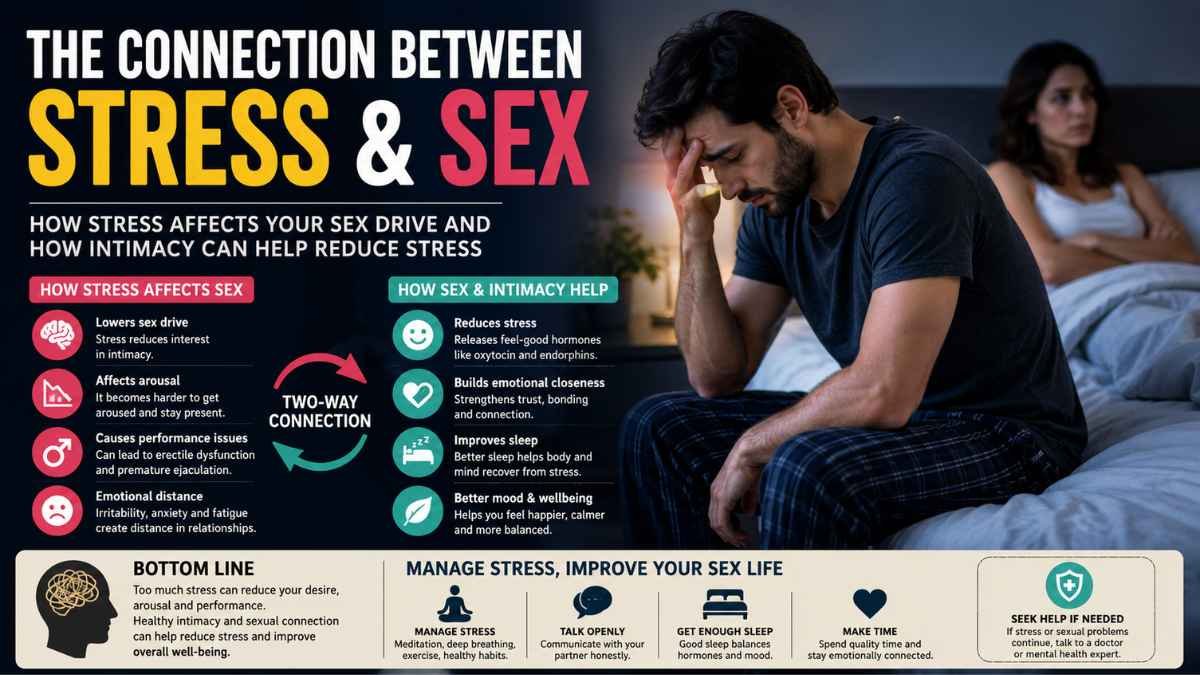
The connection between stress and sex is stronger than many people realize. When stress becomes part of everyday life, it can affect much more than your mood, sleep or concentration. It can also change your sex drive, sexual arousal, erections, orgasm and overall interest in intimacy.
At the same time, healthy sexual intimacy may help some people feel more relaxed and emotionally connected.
This creates an interesting relationship between the two: stress can affect sex, while intimacy and sexual activity may sometimes influence how the body responds to stress.
So what exactly happens inside the body?
How does stress affect sex drive?
One of the most common effects of prolonged stress is a reduction in sexual desire.
When you are constantly worrying about money, work, studies, family problems, relationships or other responsibilities, your brain may simply stop treating sex as a priority.
Cleveland Clinic lists stress, anxiety, depression, relationship problems and physical fatigue among factors that can reduce libido. The NHS also identifies stress, anxiety and depression as common causes of low sex drive.
This means that a person can still be physically healthy but suddenly notice:
- Less interest in sex
- Fewer sexual thoughts
- Difficulty becoming aroused
- Less desire for intimacy
- Problems reaching orgasm
- Feeling mentally distracted during sex
The change does not necessarily mean that something is permanently wrong.
Sometimes, the underlying problem is simply too much stress for too long.
Why does stress reduce sexual desire?
Sexual desire is not controlled by one single hormone or one part of the body.
It involves the brain, emotions, hormones, nerves, blood flow and relationship factors.
When someone is under significant stress, the body enters a state focused on dealing with the perceived threat or pressure. That can make relaxation and sexual arousal more difficult.
Chronic stress has also been associated with changes in cortisol and other biological processes that can influence sexual function. The American Psychological Association notes that chronic stress can affect testosterone production and may contribute to reduced libido and erectile dysfunction.
In simple terms:
Your brain is worried about surviving the stressful day, while your body is being asked to switch into a state of sexual relaxation.
That transition is not always easy.
Stress and sex: The problem of “being in your head”
One of the biggest ways stress affects sex is through distraction.
Imagine someone is having sex but thinking about:
“I have an important meeting tomorrow.”
“Why hasn't my boss replied?”
“I need to pay that bill.”
“What if I can't perform?”
The body may be physically present, but the mind is somewhere else.
Research on chronic stress and sexual function has found that higher stress can be associated with lower genital arousal, with psychological distraction playing an important role.
This is why stress and sexual arousal can sometimes work against each other.
Sexual arousal generally requires attention and a sense of comfort, while persistent stress can keep the brain focused on problems.
Can stress cause erectile dysfunction?
Yes, stress can contribute to erectile dysfunction or make existing erection problems worse.
The NHS says occasional erection problems are commonly caused by factors such as stress, tiredness or excessive alcohol consumption. Mayo Clinic also lists stress and mental health concerns among factors that can cause or worsen erectile dysfunction.
The connection can sometimes become a cycle:
Stress → difficulty getting an erection → worry about performance → more stress → greater difficulty getting an erection.
A person may then start thinking, “What if it happens again?”
That thought itself can increase anxiety during the next sexual encounter.
This does not mean every erection problem is caused by stress. Persistent erectile dysfunction can also be related to cardiovascular disease, diabetes, high blood pressure, medications, hormone problems and other medical conditions.
Can stress affect women differently?
Stress can affect sexual function in women as well.
It may reduce sexual desire, make arousal more difficult, increase mental distraction and sometimes contribute to discomfort during sex.
Mayo Clinic lists anxiety, depression, relationship problems and long-term stress among psychological factors that can contribute to female sexual dysfunction.
Research has also found a relationship between chronic stress, higher cortisol levels and reduced genital arousal in women.
So the connection between stress and sex is not simply a men's health issue.
It can affect people of different sexes in different ways.
What happens to libido when stress continues for months?
A stressful day is different from chronic stress.
Almost everyone experiences occasional stress. You may be worried before an exam, presentation, job interview or important event.
But when stress becomes persistent, its effects can become more noticeable.
Long-term stress can contribute to sleep problems, mood changes, fatigue and lower sexual interest. Mayo Clinic specifically lists lower sexual interest among the potential effects of chronic stress.
That creates another cycle:
Chronic stress → poor sleep → fatigue → lower libido → less intimacy → relationship tension → more stress.
Breaking that cycle may require addressing the original source of stress rather than simply trying to increase sexual activity.
Can sex reduce stress?
This is where the relationship becomes interesting.
Some evidence suggests that sexual activity and intimacy can be associated with lower stress, particularly when the experience is positive and occurs in a supportive relationship.
Cleveland Clinic notes that sex and intimacy may help relieve stress, while hormones and neurotransmitters released during sexual activity and orgasm may contribute to feelings of relaxation and positive emotion.
Research has also found that intimacy between partners can influence cortisol responses during stressful situations. A study involving 183 couples found that expressions of intimacy were associated with reduced cortisol responses in women and faster cortisol recovery in both men and women.
But this does not mean sex is a treatment for chronic stress.
The relationship is more complicated than that.
Sex is not a cure for stress
It would be misleading to say:
“Have sex and your stress will disappear.”
That's not what the research shows.
A 2026 study involving newlywed couples found that partnered sexual activity was associated with lower stress on the same day, but it did not produce an additional reduction in stress the following day. The researchers also found that using sex to avoid negative experiences with a partner could be associated with increased stress the next day.
So why you are having sex and what the relationship feels like can matter.
Sex that happens within a supportive, consensual and emotionally comfortable relationship may be very different from sex used as a way to escape relationship conflict or pressure.
Can intimacy help even without sex?
Yes.
This is an important part of the stress and intimacy connection.
Intimacy isn't limited to sexual intercourse.
Talking, hugging, cuddling, holding hands, spending quality time together and feeling emotionally supported can all contribute to closeness.
Research on couples has found that positive intimacy can influence physiological stress responses.
This means that if stress has temporarily reduced someone's interest in sex, there is no need to treat intercourse as the only way to maintain closeness.
Sometimes simply reconnecting with a partner can be the first step.
Why does performance anxiety make things worse?
Sexual performance anxiety is another important link between stress and sexual performance.
Someone may worry about:
- Getting or maintaining an erection
- Reaching orgasm
- Lasting “long enough”
- Satisfying their partner
- How their body looks
- Whether they will perform the same way as before
Those thoughts can take attention away from sexual pleasure.
For men, performance anxiety can contribute to erection difficulties. Once an erection problem happens, worrying about it happening again can increase stress and make the next sexual experience more difficult. Mayo Clinic specifically notes that stress surrounding erectile dysfunction can worsen the problem.
Can lack of sex cause stress?
Not necessarily.
There is no universal amount of sex that every person needs to remain mentally healthy.
Some people have a high sex drive, while others have a low sex drive. Libido can also change throughout life.
The problem is more likely to arise when there is a mismatch between what someone wants and what they are experiencing, or when relationship conflict develops around intimacy.
Cleveland Clinic notes that everyone's sex drive is different and that libido can change over time.
So having less sex during a stressful period does not automatically mean there is a health problem.
What if stress makes you lose interest in sex completely?
A temporary drop in sexual desire during a stressful period can happen.
But if low libido lasts for a long time, causes significant distress or affects a relationship, it is worth looking at the possible causes.
Stress may be responsible, but other factors can also affect libido, including:
- Depression or anxiety
- Certain medications
- Hormonal changes
- Relationship problems
- Sleep problems
- Alcohol use
- Chronic illnesses
- Sexual pain
- Erectile dysfunction or other sexual difficulties
Low libido has many possible causes, so it should not automatically be blamed on stress.
How can reducing stress improve your sex life?
If stress is affecting your sexual health, reducing the underlying stress may help.
Some practical approaches include:
Get enough sleep
Poor sleep can increase fatigue and make sexual desire harder to maintain.
Exercise regularly
Physical activity can improve mood, energy and overall health. Mayo Clinic recommends exercise as part of strategies that may help improve sexual desire.
Talk to your partner
If stress is affecting intimacy, hiding the problem can create even more pressure.
An honest conversation can help both partners understand that a temporary decrease in sexual desire does not necessarily mean a loss of attraction.
Take the pressure off sex
Not every intimate moment has to lead to intercourse.
Cuddling, kissing, talking or simply spending time together can help rebuild emotional closeness without creating performance pressure.
Address the actual source of stress
If work, money, relationship conflict or anxiety is causing the stress, dealing with that issue may be more effective than trying to solve everything through sex.
Can masturbation help with stress?
For some people, masturbation can be a way to relax and temporarily reduce tension.
Cleveland Clinic lists stress reduction, relaxation and improved sleep among potential benefits of masturbation.
However, the same principle applies here: masturbation should not be treated as a universal treatment for chronic stress.
If someone is using sexual behavior compulsively to escape difficult emotions and feels unable to control it, that can become a separate concern.
The connection works in both directions
The relationship between stress and sex is not a simple one-way road.
It can look like this:
Stress → lower desire
Stress → less arousal
Stress → erection difficulties
Stress → relationship tension
But positive intimacy may also contribute to:
Intimacy → emotional closeness
Intimacy → relaxation
Sexual activity → temporary stress reduction for some people
Emotional support → better ability to cope with stress
Recent research supports the idea that stress and sexuality influence each other, although the strength and direction of these relationships can vary between people and situations.
When should you see a doctor?
If stress is accompanied by persistent sexual problems, it is worth speaking with a healthcare professional.
Seek medical advice if you experience:
- Persistent erectile dysfunction
- A sudden or lasting change in sexual desire
- Pain during sex
- Persistent difficulty with arousal or orgasm
- Sexual problems that are affecting your relationship
- Severe anxiety or depression
- Sexual symptoms that continue even after the stressful period has improved
Persistent sexual problems can sometimes be a sign of an underlying medical or psychological condition, so assuming that “it's just stress” may delay appropriate treatment.
The Bottom Line
The connection between stress and sex is real, and it can work in both directions.
Too much stress can lower sexual desire, interfere with arousal, contribute to erection problems and make it harder to stay mentally present during intimacy. Chronic stress can also affect sleep, mood and relationships, which can further influence sexual health.
At the same time, positive sexual intimacy and emotional closeness may help some people relax and regulate stress, particularly when the relationship is supportive and the sexual experience is wanted and satisfying.
The key is not to think of sex as a medicine for stress.
Instead, think of stress management and sexual health as connected parts of overall wellbeing.
When the mind feels overwhelmed, the body may not always be ready for intimacy. And when people feel safe, connected and relaxed, intimacy can sometimes become one of the ways they experience comfort and closeness.