How much sperm is released after sex? And is the amount different when a man ejaculates during masturbation?
These are common questions, but there is an important misunderstanding behind them.
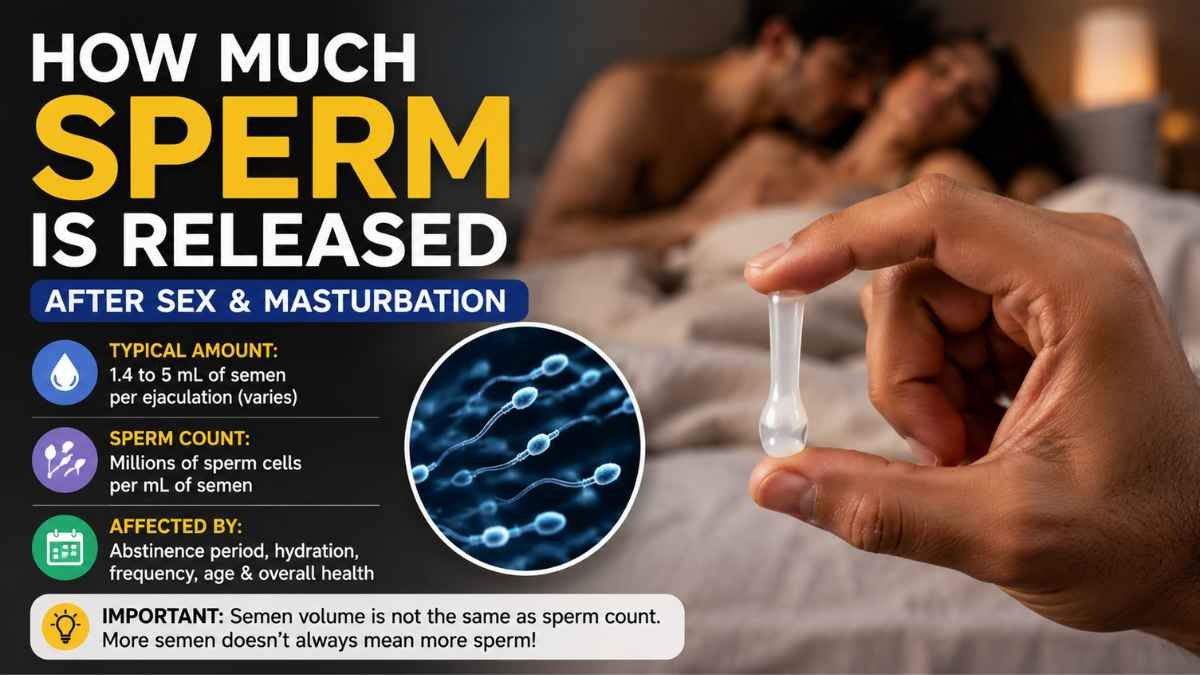
What you see after ejaculation is actually semen, not pure sperm.
Semen is a mixture of fluids from several reproductive glands, including the seminal vesicles and prostate, along with sperm cells produced by the testes. So the amount of fluid you see does not directly tell you how many sperm cells were released.
For most men, an ejaculation produces only a few millilitres of semen.
But the exact amount can vary considerably from one ejaculation to another.
How much semen is released during ejaculation?
A typical ejaculation produces a relatively small amount of semen—usually just a few millilitres.
The World Health Organization's sixth edition laboratory manual reports a lower reference limit of 1.4 mL for semen volume based on its reference population. This is not a magic number that every healthy man must reach; semen volume naturally varies between individuals and between ejaculations. (who.int)
To put it into perspective, a few millilitres is roughly around half a teaspoon or less, although actual volumes can be higher or lower.
So if someone expects a large amount of fluid every time, normal ejaculation may look surprisingly small.
Is the fluid actually sperm?
No.
This is one of the biggest myths about ejaculation.
Sperm are microscopic reproductive cells.
Semen is the fluid that carries those sperm cells.
Most of the semen volume comes from fluids produced by the seminal vesicles and prostate, with smaller contributions from other glands.
The sperm cells themselves make up only a small proportion of the total semen volume.
So:
More semen does not automatically mean more sperm.
And:
Less semen does not automatically mean low sperm count.
Semen analysis is needed to properly assess sperm concentration and other fertility parameters.
How much sperm is released after sex?
If by “sperm” you mean semen volume, ejaculation during sex generally produces a similar type of fluid as ejaculation during masturbation.
There is no rule that says a man must release a specific amount after intercourse.
The volume can be influenced by:
- How recently he ejaculated
- Hydration
- Age
- Duration of sexual abstinence
- Individual biology
- Certain medications
- Medical conditions
- Ejaculatory frequency
Therefore, the amount released after sex can vary from one occasion to another.
How much semen is released during masturbation?
The answer is broadly similar.
Masturbation and sex both result in ejaculation of semen, assuming ejaculation occurs.
The volume isn't determined simply by whether ejaculation happened during intercourse or masturbation.
If a man masturbates several times within a short period, the amount of semen produced in later ejaculations may be lower.
That does not necessarily mean anything is wrong.
The reproductive system needs time to replenish semen components and sperm.
Does masturbation reduce sperm permanently?
No.
This is another common myth.
Frequent ejaculation can temporarily affect semen parameters, particularly the amount of semen and the number of sperm in a single ejaculation, but it does not mean the body permanently runs out of sperm.
The testes continuously produce sperm.
Sperm production is an ongoing biological process.
This is one reason semen volume can change depending on how recently someone ejaculated.
Why is less semen released after repeated masturbation?
Suppose someone ejaculates twice within a few hours.
The second ejaculation may produce less semen than the first.
If ejaculation happens repeatedly over a short period, the volume can become smaller still.
This is generally understandable because the reproductive glands have had less time to replenish their secretions.
The same principle applies to sperm concentration: frequent ejaculation can temporarily reduce the number of sperm in an individual ejaculate.
That does not mean sperm production has stopped.
Does waiting longer increase semen volume?
It can.
The period between ejaculations can influence semen volume and sperm concentration.
A longer period of sexual abstinence may increase semen volume in the next ejaculation, although this doesn't mean that longer abstinence is automatically better for fertility.
For fertility testing, laboratories generally provide specific abstinence instructions because the timing can influence semen-analysis results.
The WHO manual provides standardized recommendations for semen collection and analysis precisely because factors such as abstinence duration can affect the sample. (who.int)
Does more semen mean higher fertility?
No.
This is extremely important.
A man can produce a relatively large volume of semen but still have a low sperm concentration or poor sperm motility.
Another man may produce a smaller volume while having healthy sperm concentration and motility.
Male fertility depends on several semen parameters, including:
- Semen volume
- Sperm concentration
- Total sperm number
- Sperm motility
- Sperm morphology
A semen analysis evaluates these characteristics rather than simply looking at how much fluid was ejaculated.
What is a normal sperm count?
Sperm count is different from semen volume.
The WHO reference data use 16 million sperm per millilitre as the lower fifth-percentile reference value for sperm concentration, and 39 million sperm per ejaculate for total sperm number. These are reference values from a fertile reference population, not a simple pass/fail fertility diagnosis. (who.int)
This illustrates why saying:
“I ejaculated a lot, so my sperm count must be high.”
is not scientifically reliable.
You cannot estimate sperm count by looking at semen.
Can you see sperm in semen?
Not individually.
Sperm cells are microscopic.
The whitish appearance of semen is produced by the combination of fluids, cells and other components.
Even if semen looks thick and white, you cannot determine sperm concentration simply by looking at it.
Likewise, watery-looking semen does not automatically mean that sperm count is low.
Only laboratory analysis can provide useful information about sperm concentration and other semen parameters.
Why does semen sometimes look thick?
Fresh semen can appear thick, sticky or jelly-like immediately after ejaculation.
It normally undergoes a process called liquefaction, becoming more fluid over time.
This is a normal part of semen physiology.
Therefore, the appearance immediately after ejaculation should not be used to diagnose fertility problems.
If there are persistent abnormalities or fertility concerns, a semen analysis is much more informative.
Why does semen sometimes look watery?
Semen consistency can vary.
After frequent ejaculation, the semen may appear thinner or the volume may be lower.
Hydration, abstinence duration and individual variation can also influence appearance.
A single episode of watery semen usually does not prove low sperm count.
If a change is persistent and accompanied by fertility concerns or other symptoms, medical evaluation can help determine the cause.
Does dehydration reduce semen volume?
Hydration status can influence body fluids, and being dehydrated may contribute to lower fluid output.
But it is not accurate to say that drinking a large amount of water immediately before sex will dramatically increase semen volume.
Semen production is a biological process, not something that can be instantly increased by drinking water.
Good hydration is still important for general health.
Does drinking milk, eating eggs or certain foods increase sperm?
There is no single food that guarantees a larger ejaculation.
Sperm production is influenced by overall health, nutrition, hormones, genetics, lifestyle and medical conditions.
A balanced diet, adequate sleep, regular physical activity and avoiding smoking and excessive alcohol are generally more meaningful for reproductive health than chasing a particular food or supplement.
Does masturbation cause low sperm count?
For most healthy men, masturbation does not permanently lower sperm production.
Frequent ejaculation may temporarily reduce the number of sperm present in an individual ejaculation, particularly when ejaculations are close together.
But the body continues producing sperm.
So the myth that masturbation permanently “finishes your sperm” is incorrect.
Does sex release more sperm than masturbation?
There is no general rule that sex automatically produces more sperm than masturbation.
Both can lead to ejaculation, and the amount depends more on individual physiology and factors such as the time since the previous ejaculation than on whether the ejaculation occurred during intercourse or masturbation.
The idea that intercourse must produce a larger ejaculation is not supported by basic reproductive physiology.
What happens to sperm that isn't ejaculated?
The testes continuously produce sperm.
Sperm that are not ejaculated do not simply build up forever.
Older sperm are eventually broken down and reabsorbed by the body.
This is one reason regular ejaculation does not cause the body to “run out” of sperm.
The reproductive system is constantly producing new sperm cells.
Does sperm come out every time a man ejaculates?
Normally, semen contains sperm, but the amount can vary.
Some men can have very low sperm counts, and some medical conditions can result in azoospermia, meaning no sperm are detected in the semen.
Therefore, seeing semen does not guarantee that sperm are present in normal numbers.
If fertility is a concern, a semen analysis is the appropriate test.
What if very little semen comes out?
Occasionally having a small-volume ejaculation is not necessarily a problem.
It can happen after repeated ejaculation or due to normal variation.
However, persistently very low semen volume can sometimes be associated with conditions affecting the reproductive tract, hormones or ejaculation.
Certain medications and medical conditions can also influence ejaculation.
If the change is persistent, particularly if there is also difficulty conceiving, it is worth discussing with a healthcare professional.
What if no semen comes out?
A man can experience an orgasm without visible semen in some circumstances.
This can happen with conditions such as retrograde ejaculation, where semen travels backward into the bladder instead of exiting through the penis.
Some medications, surgeries and medical conditions can contribute to this.
If someone repeatedly experiences a “dry orgasm,” particularly if it begins suddenly, medical evaluation is appropriate.
Does a large amount of semen mean stronger orgasm?
No.
Semen volume does not determine orgasm intensity.
A man can experience a strong orgasm with a relatively small ejaculation and a weaker orgasm with a larger volume.
Sexual pleasure involves the nervous system, brain, muscles, hormones and psychological factors—not simply the quantity of semen released.
Can you increase semen volume naturally?
There is no guaranteed method for dramatically increasing semen volume.
Some factors can influence it, including allowing more time between ejaculations and maintaining general health.
But many products marketed online as “semen volume boosters” make claims that are not well supported by clinical evidence.
If someone has a persistent change in ejaculation volume, the better approach is to investigate the cause rather than relying on supplements.
When should you worry about semen volume?
You should consider medical advice if you notice a persistent and significant change in ejaculation, especially when accompanied by:
- Pain during ejaculation
- Blood in semen
- Erectile problems
- Difficulty reaching orgasm
- Repeated dry orgasms
- Urinary symptoms
- Testicular pain or swelling
- Difficulty conceiving
Blood in semen can have several causes and is often not serious, but persistent or recurrent blood should be evaluated.
Similarly, a sudden change in ejaculation after starting a medication or undergoing surgery should be discussed with a healthcare professional.
The Bottom Line
So, how much sperm is released after sex or masturbation?
The more accurate question is actually:
“How much semen is released?”
A typical ejaculation contains only a few millilitres of semen, and the WHO's current reference data place 1.4 mL as the lower reference limit for semen volume.
But semen volume and sperm count are two different things.
More semen does not automatically mean more sperm.
Less semen does not automatically mean infertility.
And masturbation does not permanently “empty” the body's sperm supply.
The amount can naturally change depending on how recently you ejaculated, individual biology and other factors.
If you are worried about fertility, don't judge your sperm health by the amount of semen you see.
A laboratory semen analysis—not the eye—is what can actually tell you about sperm concentration, movement and other important fertility parameters.