Is it safe to swallow female ejaculate? This is a question many people have but rarely ask openly.
Female sexual fluids are often misunderstood. Some women release a small amount of fluid during sexual arousal or orgasm, while others may experience squirting, which generally involves a larger amount of fluid.
But is it actually safe for a partner to swallow this fluid?
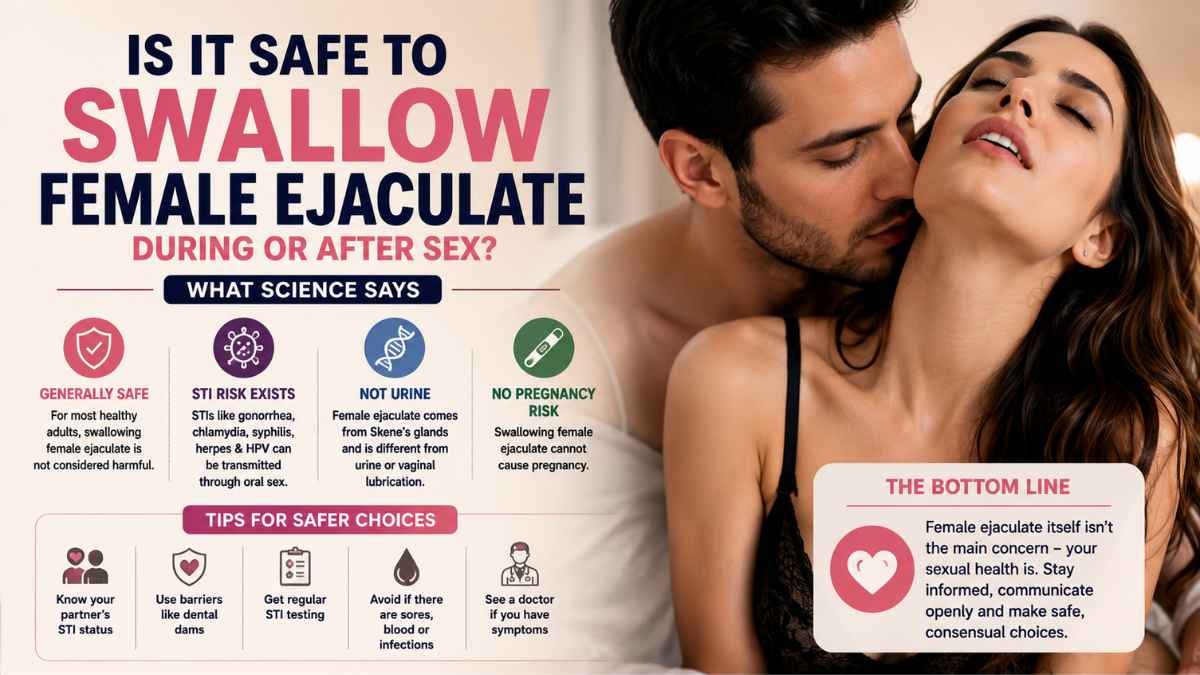
For most healthy adults, swallowing female ejaculate itself is not considered harmful. However, the more important issue is not the fluid itself—it is whether the partner has a sexually transmitted infection or another condition that can be transmitted through sexual contact.
That means the answer isn't simply “yes” or “no.”
It depends on the circumstances.
First, what exactly is female ejaculate?
Female ejaculation is generally described as a relatively small amount of fluid released through the urethra during sexual arousal or orgasm.
The International Society for Sexual Medicine says female ejaculate is thought to originate from the Skene's glands, also called the paraurethral glands. It can appear thick, milky, white or gray, and researchers have identified prostate-specific antigen (PSA) in some samples.
This is different from ordinary vaginal lubrication.
It is also different from squirting, which usually involves a larger amount of clearer fluid and appears to have a substantial bladder-derived component.
So when people search “is female ejaculation safe to swallow?”, they may actually be talking about several different types of sexual fluid.
Is it safe to swallow female ejaculation?
For a person without relevant infections or allergies, there is generally no known inherent danger from swallowing a small amount of female ejaculate.
Female ejaculate is a naturally produced bodily fluid.
The bigger health consideration is whether it contains an infectious organism.
This is similar to other forms of oral sexual contact: the risk comes primarily from possible sexually transmitted infections, rather than the fact that the fluid is female ejaculate.
The CDC notes that oral sex carries little to no risk for HIV compared with vaginal or anal sex, but other STIs can still be transmitted through oral sexual activity.
Can you get an STI from swallowing female sexual fluid?
Yes, depending on the infection and the sexual contact involved.
Oral sexual activity can transmit several STIs, including:
- Gonorrhea
- Chlamydia
- Syphilis
- Herpes
- HPV
The CDC specifically notes that several STIs can be transmitted during oral sex.
So the important question isn't simply:
“Is female ejaculation safe?”
A better question is:
“Do both partners know their STI status?”
That makes a much bigger difference to the overall risk.
What about HIV?
HIV transmission through oral sex is considered extremely low to negligible compared with vaginal or anal sex.
The CDC states that there is little to no risk of getting or transmitting HIV through oral sex, although certain factors can increase risk.
Factors such as:
- Open sores in the mouth
- Bleeding gums
- Genital sores
- Blood exposure
- Other sexually transmitted infections
can affect the risk profile.
So it would be inaccurate to say that oral exposure carries exactly the same HIV risk as vaginal or anal sex.
It doesn't.
But “very low risk” is not the same as “no possible risk in every situation.”
Can female ejaculation contain bacteria?
The genital and urinary areas naturally contain microorganisms.
That doesn't mean female ejaculate is inherently dangerous.
The body normally lives with a large number of microorganisms without causing disease.
The concern arises when a person has an infection that can be transmitted through sexual contact.
For example, some infections affecting the genital tract can also be transmitted through oral sexual activity.
This is why symptoms and STI status matter more than the appearance of the fluid.
What about squirting fluid?
Squirting is different from female ejaculation.
Research indicates that squirting fluid is generally clearer and can contain a substantial bladder-derived component. Some studies have also identified compounds associated with the Skene's glands.
Because of this, someone may wonder:
“Is squirting fluid safe to swallow?”
Again, the answer depends primarily on the person's health and infection status.
Squirting itself isn't considered a disease.
But if a person has an infection that can be transmitted through sexual contact, the risk isn't eliminated simply because the fluid is produced during sexual stimulation.
Is female ejaculate the same as urine?
No—not exactly.
This is one of the biggest myths surrounding female ejaculation.
The ISSM explains that female ejaculate is associated with the Skene's glands and can contain PSA, while squirting fluid has a different composition and can have a bladder-derived component.
So saying:
“Female ejaculation is just urine.”
is an oversimplification.
At the same time, squirting and female ejaculation should not automatically be treated as exactly the same fluid.
The distinction matters when discussing the science.
Can swallowing female ejaculation cause pregnancy?
No.
Swallowing sexual fluid cannot cause pregnancy.
Pregnancy requires sperm to reach the reproductive tract and fertilize an egg.
The digestive system and reproductive system are separate.
Therefore, swallowing female ejaculate or squirting fluid has no mechanism for causing pregnancy.
Pregnancy concerns apply to sperm entering the vagina or otherwise reaching the reproductive tract—not to swallowing fluid.
Does swallowing female ejaculation have health benefits?
There is no established medical evidence that swallowing female ejaculate provides special health benefits.
You may find claims online suggesting that sexual fluids contain nutrients or substances that make swallowing them beneficial.
Those claims should be treated cautiously.
The fact that a biological fluid contains proteins, enzymes or other compounds does not automatically mean consuming it provides a meaningful nutritional or health benefit.
So there is no scientific reason to swallow female sexual fluid specifically for supposed health benefits.
Does female ejaculation contain nutrients?
Like other biological fluids, female ejaculate contains various compounds.
Researchers have identified substances including PSA in some female ejaculate samples.
But the amount is not something that should be viewed as a meaningful nutritional source.
There is no established dietary benefit from swallowing female ejaculate.
In other words:
It is a sexual fluid, not a health supplement.
Can someone be allergic to female sexual fluids?
Allergic reactions to sexual fluids are rare, but they can happen.
Medical literature most commonly discusses seminal plasma allergy, which is an allergy to proteins in semen. Cleveland Clinic notes that reactions can occur when semen contacts the mouth or throat, although severe reactions are rare.
Female sexual fluids are chemically different from semen, and there is much less evidence about true allergy to female ejaculate specifically.
So if someone develops unusual symptoms after contact with sexual fluids, it should not automatically be assumed to be an STI.
Other causes, including irritation or allergy, may need consideration.
What symptoms should you watch for?
If someone develops symptoms after oral sexual contact, possible warning signs include:
- Mouth or throat swelling
- Hives
- Burning or itching
- Unusual sores
- Persistent sore throat
- Difficulty swallowing
- Difficulty breathing
A severe allergic reaction involving swelling of the lips, tongue or throat or difficulty breathing requires urgent medical attention. Cleveland Clinic notes that semen allergy can rarely cause systemic reactions.
Persistent mouth or throat symptoms after sexual exposure can also warrant medical evaluation for an STI or another condition.
Does oral sex always transmit an STI?
No.
Having oral sex with someone who does not have an STI does not magically create an STI.
The risk exists when an infection is present and can be transmitted through the particular sexual contact.
The CDC describes oral sex as substantially lower risk for HIV than vaginal or anal sex, while noting that several other STIs can still be transmitted through oral contact.
So the right approach is risk assessment, not fear.
Does using a dental dam reduce the risk?
Yes.
A dental dam or other suitable barrier can reduce direct contact between the mouth and genital fluids during oral sex.
The CDC recommends barriers such as dental dams for reducing exposure to body fluids during oral sex.
This can be particularly relevant when:
- STI status is unknown
- There is a new sexual partner
- One partner has an STI
- There are visible sores
- There is blood present
- Either partner has symptoms
What if both partners have been tested?
If both partners have been appropriately tested and are in a mutually agreed, exclusive relationship, the STI concern is substantially different from a situation involving an unknown or new partner.
However, testing needs to be appropriate to the infections and exposures involved.
Some infections can exist without symptoms.
That's why “I feel healthy” doesn't necessarily mean “I cannot have an STI.”
Can you swallow female ejaculation during or after sex?
From a medical perspective, swallowing female ejaculate isn't inherently dangerous for most healthy adults.
The main considerations are:
1. STI status
2. Any unusual symptoms
3. Rare sensitivity or allergic reactions
4. Whether either partner has open sores or bleeding
If those concerns are absent, there isn't a special medical rule saying that female ejaculate must not be swallowed.
It is ultimately a personal sexual choice between consenting adults.
Is it different from swallowing semen?
The health considerations are different because the fluids have different compositions.
Semen is produced by the male reproductive system and can carry certain infections.
Female ejaculate is produced by paraurethral glands and differs chemically from semen.
However, both are bodily fluids, and sexual infections can be transmitted through sexual contact involving infected genital fluids.
So neither fluid should be considered automatically “safe” simply because it comes from a healthy-looking partner.
Does swallowing female fluid after sex clean the vagina?
No.
This is another myth.
Swallowing sexual fluid has nothing to do with vaginal cleansing.
The vagina naturally maintains its own environment, and there is no health benefit to trying to “remove” vaginal fluid after sex by swallowing it.
Likewise, there is no need to wash inside the vagina after sexual activity.
What if the fluid tastes or smells different?
Female sexual fluid can vary in smell and taste.
Changes can be influenced by:
- Hormonal changes
- Menstrual cycle
- Hydration
- Diet
- Sexual activity
- Normal vaginal bacteria
A mild natural smell does not automatically indicate a health problem.
However, a new strong or unpleasant odour, especially with unusual discharge, itching, burning or pain, may indicate an infection or another condition and should be checked.
What if there is blood mixed with the fluid?
Blood changes the situation.
Blood can increase exposure concerns for certain infections, particularly when there are cuts, sores or bleeding gums in the mouth.
If blood is repeatedly present during or after sexual activity, the cause should be investigated.
Bleeding after sex can have multiple causes and shouldn't automatically be dismissed.
Can oral sex cause a sore throat?
Yes.
A sore throat after sexual activity can have many causes, including an ordinary viral infection.
But some sexually transmitted infections can infect the throat after oral sexual exposure.
For example, gonorrhea can infect the throat, and other infections can also be transmitted through oral sex. The CDC specifically notes the possibility of STIs being transmitted through oral sex.
If a persistent sore throat follows a potential STI exposure, medical testing may be appropriate.
What is the safest approach?
If both partners know their STI status and neither has concerning symptoms, the health risk from swallowing female sexual fluid is generally low.
If STI status is unknown, a barrier method such as a dental dam can reduce exposure.
Regular STI testing is also important for sexually active people, particularly when partners change.
The CDC recommends barrier protection for oral sex to reduce exposure to STIs.
Biggest myths about swallowing female ejaculation
Myth 1: Female ejaculation is poisonous
False.
There is no evidence that female ejaculate is inherently toxic.
Myth 2: Swallowing it causes pregnancy
False.
Swallowed sexual fluid cannot cause pregnancy.
Myth 3: Female ejaculation is always urine
False.
Female ejaculation and squirting have different characteristics and are not simply interchangeable terms.
Myth 4: Swallowing it gives special health benefits
Not proven.
There is no established nutritional or medical benefit from swallowing female ejaculate.
Myth 5: Oral sex cannot transmit STIs
False.
Several STIs can be transmitted through oral sexual activity.
Myth 6: If someone looks healthy, they cannot have an STI
False.
Many sexually transmitted infections can be asymptomatic.
When should you talk to a doctor?
Medical evaluation is sensible if you develop:
- Persistent mouth or throat symptoms
- Unusual sores
- Genital symptoms
- Burning or pain
- Unusual discharge
- A strong new odour
- Swelling after contact with sexual fluids
- Hives
- Difficulty breathing
- Any concern about a possible STI exposure
If there is difficulty breathing or significant swelling of the lips, tongue or throat after exposure to a sexual fluid, seek urgent medical care because a severe allergic reaction is possible.
The Bottom Line
So, is it good or safe to swallow female ejaculate during or after sex?
For most healthy adults, female ejaculate itself isn't considered inherently harmful to swallow.
The bigger issue is sexual health status.
Female ejaculation is a natural sexual response associated with the Skene's glands, while squirting is a different type of fluid release that can have a substantial bladder-derived component.
There is no proven special health benefit to swallowing either fluid.
And while the risk of HIV transmission through oral sex is extremely low, other STIs—including gonorrhea, chlamydia, syphilis, herpes and HPV—can be transmitted through oral sexual contact.
So the simplest rule is:
The fluid itself isn't the main concern. The health status of the people involved is.
For partners who know their STI status and have no concerning symptoms, swallowing female sexual fluid is generally not considered dangerous.
If STI status is unknown, symptoms are present, or there is blood or open sores involved, using a barrier and considering appropriate STI testing is the safer approach.